Blog

  • Florida Commercial Property Acquisition Services: A Strategic 2026 Guide

    Florida Commercial Property Acquisition Services: A Strategic 2026 Guide

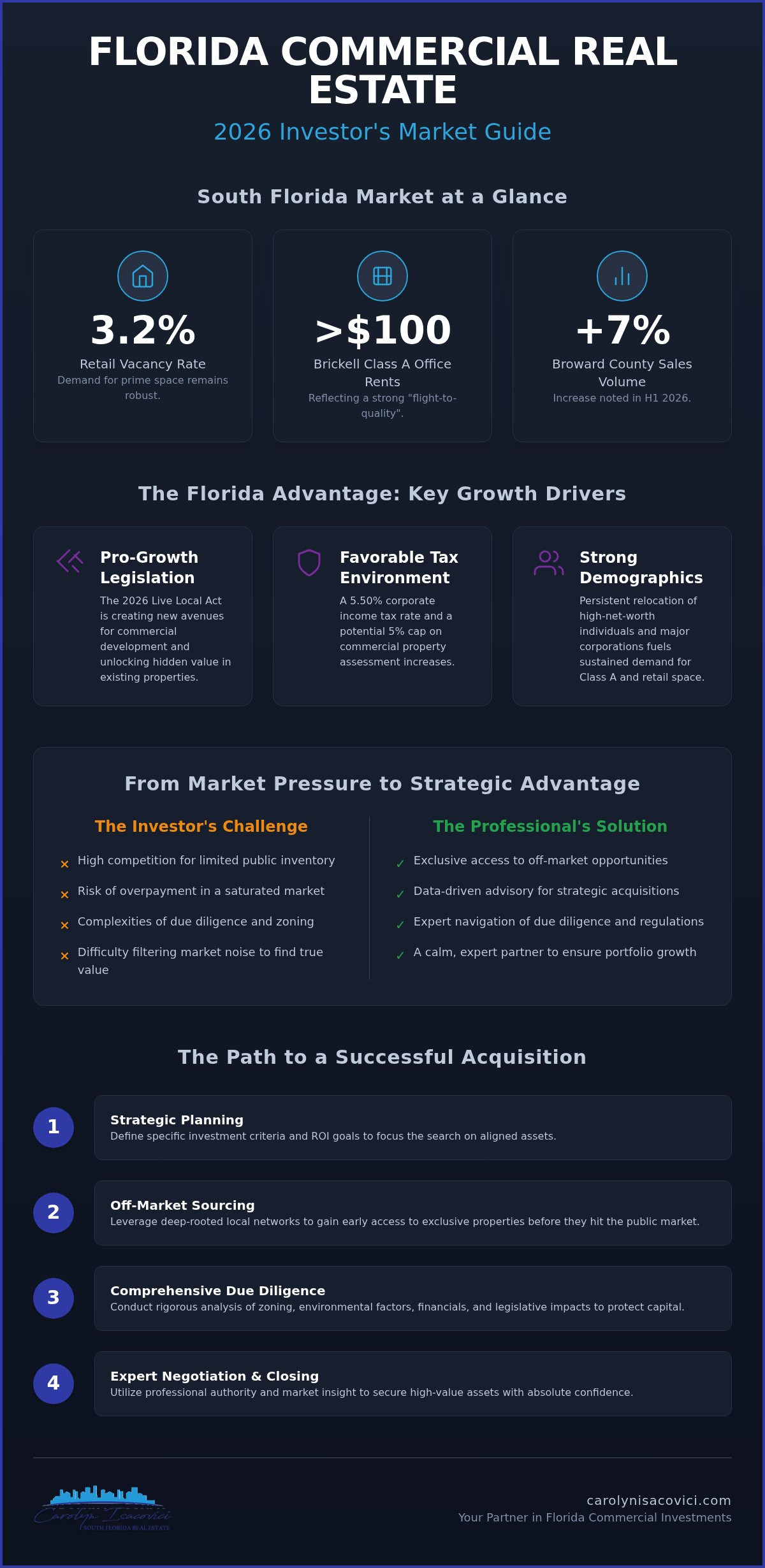
    Did you know that despite a shifting economy, South Florida’s retail vacancy rates have tightened to a remarkable 3.2% as of early 2026? It’s a clear signal that the demand for prime space remains robust, yet for many investors, finding the right Florida commercial property acquisition services to navigate this density is the real challenge. You’ve likely felt the pressure of competing for limited inventory in Broward or Miami-Dade, where the “flight-to-quality” has pushed Class A office rents in Brickell past the $100 mark. Is it possible to find value in such a crowded arena? Absolutely, provided you have the right map.

    We’re here to help you turn that market pressure into a clear, actionable strategy. By partnering with a seasoned guide, you can move beyond public listings to uncover the off-market gems that others miss. This guide will walk you through the nuances of the 2026 Live Local Act updates and the potential 5% property tax assessment cap, ensuring you’re prepared for every variable. We’ll show you how a professional partner simplifies due diligence and identifies high-yield opportunities, providing the steady hand you need to secure a high-value asset and grow your portfolio with absolute confidence.

    Key Takeaways

    • Understand how the 2026 Live Local Act and shifting tax landscapes are creating new avenues for commercial growth across the state.
    • Discover how elite Florida commercial property acquisition services provide access to exclusive off-market assets that never reach the public eye.
    • Pinpoint high-value opportunities in South Florida’s most resilient hubs, from the luxury towers of Miami to the thriving retail corridors of Hollywood.
    • Navigate the complexities of due diligence, zoning, and environmental checks with a proven roadmap designed to protect your capital.
    • Leverage the insight of a seasoned real estate professional to transform market uncertainty into a strategic advantage for your investment portfolio.

    Entering the Florida market in 2026 requires a perspective that balances rapid growth with seasoned stability. While national trends might suggest a cooling period, Florida’s commercial sector continues to demonstrate remarkable resilience. This isn’t just about finding a building. It’s about understanding the underlying real estate investing principles that drive long-term value in a high-demand environment. Professional Florida commercial property acquisition services have evolved to meet this need, moving beyond the role of a simple finder to become a strategic partner in your portfolio expansion.

    High-value real estate holdings in this cycle are no longer defined solely by a prestigious address. Instead, value is found in properties with “Live Local” potential or those situated in high-growth corridors like Broward County, which saw a 7% increase in sales volume in the first half of 2026. Identifying these assets requires a deep dive into local zoning and upcoming legislative shifts that could unlock hidden value in existing commercial footprints. A specialized Florida real estate broker acts as a seasoned guide, ensuring that every acquisition is backed by rigorous analysis and an intimate knowledge of local market cycles.

    Why Florida Remains a Premier Investment Destination

    Why is the sunshine state still the top choice for savvy investors? The answer lies in the persistent demographic shift toward the Southeast. As high-net-worth individuals and major corporations relocate to hubs like Miami and West Palm Beach, the demand for Class A office space and tight retail corridors remains high. With a corporate income tax rate of 5.50% and a proposed constitutional amendment that could cap commercial property assessment increases at 5%, the financial incentives are clear. These factors create a supportive environment where capital can be deployed with a sense of security and long-term vision.

    The 2026 Florida Advantage is defined by a unique convergence of pro-growth legislation, such as the Live Local Act, and a resilient tax structure that transforms regional stability into long-term equity.

    The Shift from Transactional to Advisory Acquisition

    In a saturated market, a transactional approach often leads to missed opportunities or overpayment. Today’s investors are looking for a “calm expert” who can filter out the noise of high competition. This shift toward advisory acquisition means focusing on data-driven insights rather than just closing a deal. It’s about looking ahead to see how a property will perform in three, five, or ten years.

    When you explore Florida commercial real estate for sale, you are looking for more than a square footage figure. You are seeking a strategic asset that aligns with your specific ROI goals. Florida commercial property acquisition services now provide the end-to-end brokerage support necessary to turn a complex market into a series of manageable, profitable steps. By prioritizing timing and professional guidance, you can move from uncertainty to a position of strategic advantage.

    Core Elements of Professional Property Acquisition Services

    Why settle for the leftovers on public listing sites? In a market as dynamic as Florida’s, the most valuable assets are often secured before they ever hit the open market. Professional Florida commercial property acquisition services provide the strategic framework necessary to identify these “quiet” opportunities. It’s a process that goes far beyond a simple property search; it’s about leveraging deep-rooted connections to find assets that match your specific investment criteria. From the initial inquiry to the final closing, having a seasoned guide ensures that every step is handled with precision and professional authority.

    Unlocking Off-Market Opportunities

    Why do the most lucrative deals often bypass the public eye? Many high-value property owners prefer the discretion of off-market sales to maintain stability for existing tenants or avoid unnecessary market speculation. A specialized Miami commercial real estate broker uses their local network to gain early access to these pre-listing deals. By choosing a boutique firm like Carolyn Isacovici, you benefit from a “calm expert” who prioritizes your success over high-volume transactions. This early access gives you a significant competitive edge in high-demand areas like South Florida, where speed and timing are everything.

    Aligning Assets with Portfolio Strategy

    Does every high-yield property belong in your portfolio? Not necessarily. Strategic asset selection means matching your current risk tolerance with the right asset class. For example, the industrial sector in South Florida remains exceptionally tight with regional vacancy rates around 5.7%, while the office sector is seeing a distinct “flight-to-quality” in prime locations. Understanding the nuances of Florida real estate portfolio building allows you to diversify effectively and protect your capital against market shifts.

    Whether you’re weighing the long-term stability of multi-family housing under the Live Local Act or the high absorption rates of retail hubs, a professional partner helps you filter choices through the lens of your ROI goals. This advisory approach ensures you aren’t just buying real estate; you’re securing a future. It involves analyzing cap rates, vetting local zoning changes, and managing the intricate due diligence that defines a successful acquisition. If you want to move forward with a clear, documented strategy, consulting with a knowledgeable real estate professional is the first step toward securing your next high-value asset.

    Strategic Site Selection Across South Florida’s Key Hubs

    Where you choose to plant your capital is just as critical as the asset class itself. Florida isn’t a monolith; it’s a collection of distinct micro-markets, each with its own rhythm and growth trajectory. Expert Florida commercial property acquisition services don’t just follow the headlines. They look beneath the surface to find where infrastructure, demographics, and local policy intersect. Whether you’re drawn to the high-energy skyline of Miami or the expanding horizons of the Treasure Coast, understanding these geographic nuances is the key to a resilient portfolio.

    The Miami-Dade and Broward Powerhouse

    Miami remains the state’s undeniable global gateway, particularly for luxury retail and high-demand industrial assets. Even as the market stabilizes, Miami real estate market trends continue to dictate regional pricing and investor expectations. In the first half of 2026, Miami-Dade saw $2.05 billion in sales volume, maintaining its status as a primary target for international capital. However, the real growth story for 2026 often points toward Broward County.

    Broward outperformed its southern neighbor in volume growth, reaching $2.35 billion in sales, a 7% increase year-over-year. In corridors like Hollywood and Fort Lauderdale, retail vacancy rates are incredibly tight, sitting between 3.2% and 3.5%. This scarcity makes identifying high-yield pockets a matter of professional timing and deep local networks. When you’re competing for Class A office space in these hubs, having a seasoned guide ensures you don’t just win the bid, but you win at the right price.

    Emerging Markets: From Jupiter to Vero Beach

    As the southern hubs become more saturated, we’re seeing a steady northward migration of capital. While Palm Beach and Palm Beach Gardens offer unmatched prestige and stability, the Treasure Coast is where many investors are finding their next big opportunity. Stuart, Port Saint Lucie, and Jupiter have transitioned from quiet residential escapes to primary targets for industrial and retail expansion.

    • Jupiter and Palm City: High-net-worth migration is fueling a surge in upscale retail and boutique office demand.
    • Port Saint Lucie: Strategic highway access and available land have made this a distribution powerhouse for the industrial sector.
    • Vero Beach and Melbourne: These markets offer lower entry points with significant upside as population growth continues to move up the coast.

    Strategic site selection in these emerging areas requires a navigator who understands local zoning nuances and the specific growth drivers of each municipality. By looking toward the Treasure Coast, you’re positioning your portfolio for long-term appreciation in areas that are just beginning to see their full commercial potential. It’s about seeing the opportunity before it becomes common knowledge, a hallmark of professional Florida commercial property acquisition services.
    Florida Commercial Property Acquisition Services: A Strategic 2026 Guide

    The Acquisition Roadmap: From Due Diligence to Closing

    How do you bridge the gap between identifying a high-value asset and signing the final deed? It requires a disciplined roadmap that balances speed with surgical precision. In a competitive seller’s market, having elite Florida commercial property acquisition services means your offer isn’t just a number; it’s a professionally backed commitment. A seasoned real estate professional manages the intricate dance of due diligence, ensuring that no stone is left unturned while keeping the momentum toward a successful closing.

    Financial Analysis and Valuation Metrics

    What defines a truly profitable asset in today’s market? It’s not just the current rent roll; it’s the projected net operating income (NOI) after accounting for 2026 assessment caps and evolving insurance costs. To evaluate investment property Florida metrics accurately, you must look beyond the surface level pro-forma numbers. Stress-testing cap rates against potential interest rate fluctuations ensures your portfolio remains resilient under various economic scenarios. This analytical rigor transforms a simple purchase into a calculated strategic move that prioritizes long-term stability.

    Mitigating Risk Through Due Diligence

    Does the property’s zoning align with your long-term goals? In Florida, zoning and environmental complexities can be particularly dense, especially for coastal assets or properties impacted by the Live Local Act. A comprehensive investor’s checklist must include everything from Phase I environmental assessments to verifying that title history is clear of encumbrances. Your broker acts as the central hub, coordinating with engineers and specialized professionals to resolve issues before they become deal-breakers. This level of oversight provides the peace of mind that your capital is protected from hidden liabilities.

    Securing favorable terms in a tight market often comes down to the strength of your due diligence period. By presenting a clean, well-vetted path to closing, you become the preferred buyer for sophisticated sellers who value certainty. If you are ready to move forward with an acquisition strategy that prioritizes clarity and risk management, contact our team of commercial experts today to start your consultation. We ensure that every detail of the end-to-end sales process is handled with the steady hand of a seasoned guide.

    Partnering for Success: The Carolyn Isacovici Advantage

    Success in Florida’s commercial sector isn’t found in a spreadsheet alone. It’s found in the relationship between an investor and a partner who has navigated the state’s unique economic rhythms for nearly twenty years. When you utilize elite Florida commercial property acquisition services, you aren’t just hiring a broker. You’re aligning with a seasoned guide who understands that every market cycle presents a different set of opportunities. Whether you’re looking for high-yield industrial assets or exploring the potential of new construction, having a steady hand at the helm transforms market complexity into a clear path forward.

    A Legacy of Florida Real Estate Expertise

    Why does experience since 2006 matter? It means we’ve seen the highs, the lows, and the recoveries that define the Sunshine State. Florida Commercial Investment Properties, led by Carolyn Isacovici, takes a purely advisory approach to high-yield investment property. We don’t just facilitate transactions; we provide the strategic insight necessary to build long-term wealth. This deep-rooted expertise allows us to offer end-to-end support for commercial, residential, and new construction sales, ensuring that your entire portfolio is managed with consistent professional authority.

    Sophisticated investors prefer this model because it removes the guesswork. By focusing on brokerage and sales across major hubs from Miami to Melbourne, we provide a specialized perspective that generalist firms simply can’t match. We understand the nuances of South Florida’s zoning and the specific demographic shifts driving demand in 2026. This isn’t just about closing a deal. It’s about securing an asset that fits perfectly within your vision for the future.

    Securing Your 2026 Investment Future

    What is the logical next step for your portfolio? Perhaps it’s identifying your first major Florida asset, or maybe it’s diversifying into a new county like Broward or Palm Beach. Regardless of where you are in your journey, our brokerage services are designed to streamline the path to high-value holdings. We handle the heavy lifting of market analysis and negotiation, allowing you to focus on the bigger picture of your investment goals.

    Uncertainty doesn’t have to be a barrier. In fact, for the well-prepared investor, it’s often the greatest source of opportunity. By partnering with a “calm expert,” you can navigate the 2026 landscape with absolute confidence. If you’re ready to discuss your acquisition strategy and see how our Florida commercial property acquisition services can work for you, contact us today for a consultation. Let’s turn your investment goals into a tangible, high-value reality.

    Securing Your Future in the Florida Commercial Market

    What does it take to truly thrive in Florida’s 2026 commercial landscape? It requires more than just capital; it demands a blend of local timing, rigorous due diligence, and a strategic map of emerging hubs like the Treasure Coast. You’ve seen how the right Florida commercial property acquisition services can unlock off-market value and navigate the complexities of new tax assessments and the Live Local Act. By focusing on data-driven site selection and exhaustive financial analysis, you transform market density into a distinct portfolio advantage.

    Florida Commercial Investment Properties has been a trusted partner in this journey since 2006. As specialists in commercial and investment brokerage, we offer the calm expert guidance you need to succeed across Miami, Fort Lauderdale, and the Treasure Coast. Are you ready to move from observation to action? Secure your next high-value asset with Florida Commercial Investment Properties. We’re here to ensure your next acquisition is handled with the precision and wisdom your capital deserves. The opportunity is waiting, and the right partnership makes all the difference.

    Frequently Asked Questions

    What are Florida commercial property acquisition services?

    These are professional brokerage services that manage the end-to-end sales process for commercial buildings and high-yield investment properties. They provide a strategic framework for identifying, vetting, and securing assets that match your specific financial goals. Whether you’re targeting retail in Hollywood or office space in Miami, these services ensure every acquisition is backed by expert market analysis and a clear path to a successful closing.

    How do I find off-market commercial real estate in Miami?

    Securing off-market deals in Miami requires a deep local network and a real estate professional with long-standing industry ties. Most high-value assets never reach public listing sites because owners prefer the discretion of “quiet” transactions. A specialized broker identifies these opportunities by leveraging private relationships with property owners and institutional investors. This early access gives you a significant competitive edge in a market where timing is everything.

    What is the typical timeframe for a commercial property acquisition in Florida?

    Most acquisitions take between 60 and 120 days from the initial letter of intent to the final deed transfer. This window allows for a 30 to 45-day due diligence period followed by the time needed to finalize title work and closing documents. While some cash transactions close faster, the complexity of South Florida zoning and environmental checks usually dictates a methodical, steady pace to protect your capital.

    Why should I use a specialized broker for Florida commercial investments?

    A specialized broker provides the “calm expert” perspective needed to navigate volatile market cycles and complex local regulations. Generalists often miss the nuances of Florida’s specific legislative changes, such as the 2026 Live Local Act updates. By partnering with a firm like Florida Commercial Investment Properties, you benefit from nearly two decades of brokerage experience and a dedicated focus on high-yield investment property sales across the state.

    What due diligence is required for buying commercial property in South Florida?

    Due diligence involves a rigorous review of financial records, structural integrity, and local zoning compliance. In coastal areas like Miami Beach or Fort Lauderdale, environmental assessments and flood zone verifications are absolutely critical. You’ll also need to verify lease agreements, check for title encumbrances, and ensure the property’s current use aligns with local land-use regulations to avoid costly surprises after the deal is done.

    Can a broker help with both commercial and new construction investment?

    Yes, a versatile firm like Florida Commercial Investment Properties manages sales for both established commercial buildings and new construction developments. This dual expertise is vital for investors looking to diversify their holdings or capitalize on the northward migration of capital toward the Treasure Coast. A broker ensures that whether you’re buying a turnkey asset or a pre-construction project, the transaction is handled with the same level of professional authority.

    What are the emerging commercial hubs in Florida for 2026?

    While Miami and Fort Lauderdale remain primary targets, the Treasure Coast is a major emerging hub for 2026. Cities like Port Saint Lucie, Stuart, and Jupiter are seeing significant industrial and retail growth due to population shifts and available land. Melbourne and Vero Beach are also becoming targets for investors seeking lower entry points with high long-term appreciation potential as capital continues to migrate northward.

    How does Florida’s 2026 market affect commercial property valuations?

    Valuations in 2026 are increasingly influenced by legislative shifts and demographic trends. The proposed property tax assessment cap and the Live Local Act are reshaping how investors calculate long-term net operating income. While some submarkets are stabilizing after rapid growth, professional Florida commercial property acquisition services help you interpret these variables. We provide the clarity needed to value assets accurately and ensure you don’t overpay in high-demand corridors.

  • Florida Commercial Land: 2026 Investor’s Strategic Guide

    Florida Commercial Land: 2026 Investor’s Strategic Guide

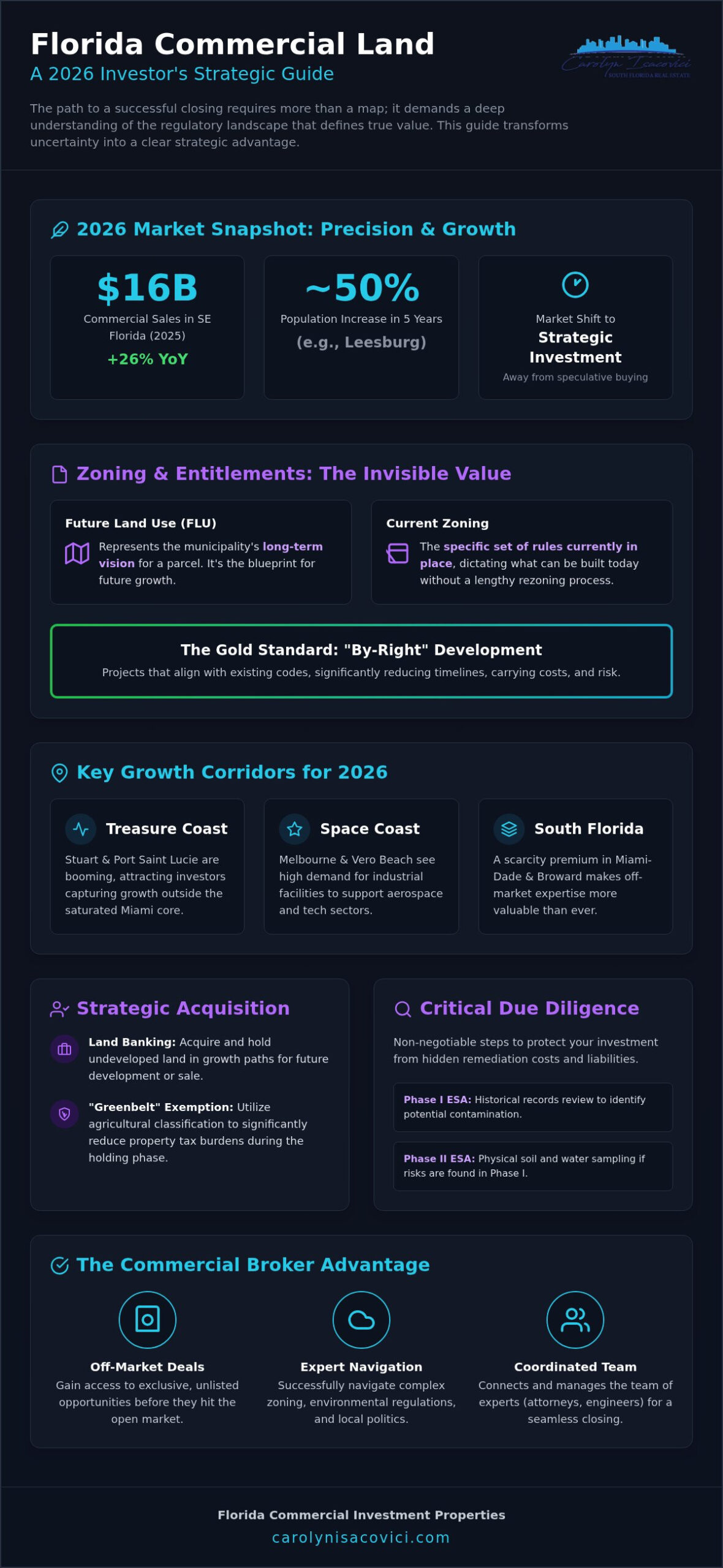
    What if the most valuable part of your next acquisition isn’t the soil itself, but the invisible layers of permits and zoning codes attached to it? It’s a realization that separates the casual buyer from the strategic investor. You already know that the Sunshine State offers unparalleled growth, yet the path to a successful closing often feels cluttered with opaque zoning laws and hidden environmental remediation costs. Searching for Florida commercial land for sale requires more than just a map; it requires a deep understanding of the regulatory landscape that defines true value.

    We’re here to transform that uncertainty into a clear strategic advantage. This guide unlocks the complexities of the 2026 market, offering expert insights on everything from South Florida’s impact fee structures to the latest pre-application consultation laws. You’ll gain a reliable roadmap that leads from initial purchase to final development while mitigating the legal and environmental risks that often stall high-potential projects. We will examine how to identify high-yield opportunities in growth hubs like Port Saint Lucie and Stuart, ensuring your next move is backed by professional wisdom and precise timing.

    Key Takeaways

    • Understand why inventory for Florida commercial land for sale remains tight in high-growth corridors and how to position yourself to capture emerging opportunities.
    • Learn to distinguish between Future Land Use and current zoning to accurately assess a property’s development potential and long-term value.
    • Identify the non-negotiable environmental due diligence steps, including Phase I and II ESAs, that protect your investment from hidden remediation costs.
    • Explore strategic acquisition models like land banking and learn how the “Greenbelt” agricultural exemption can significantly reduce your tax burden during the holding phase.
    • Discover how a seasoned commercial broker provides access to exclusive off-market deals and coordinates the expert team required for a seamless closing.

    The State of Florida Commercial Land for Sale in 2026

    2026 marks a sophisticated chapter for the Sunshine State. Is there still opportunity? The answer is a definitive yes. While the days of abundant, cheap land are behind us, the current environment rewards those with a strategic eye. The market has matured, shifting from speculative buying to a focus on precision and regulatory alignment. This evolution means that the most successful investors aren’t just looking for acreage; they’re looking for potential that has been carefully vetted against the state’s shifting economic tides.

    Inventory remains exceptionally tight in high-growth corridors like Miami and Fort Lauderdale. In 2025, commercial sales in Southeast Florida reached a staggering $16.0 billion, representing a 26% year-over-year increase. This velocity has pushed many investors toward in-fill development, where the focus shifts to maximizing smaller, underutilized parcels within established city limits. It’s a strategic pivot that requires more due diligence but often yields higher stability in the long run.

    Migration patterns remain the primary engine for this demand. Consider that Leesburg was recently one of the fastest-growing cities in the country, seeing a nearly 50% population increase over five years. This influx creates a persistent need for retail centers and industrial pads to support new residents. Because Florida’s diverse geography includes complex wetlands and coastal plains, finding viable Florida commercial land for sale requires a nuanced understanding of where the ground is literally firm enough for your specific goals.

    Defining Commercial Land Use in Florida

    Understanding the distinction between raw land and entitled pads is the first step toward a secure acquisition. Raw land is essentially a blank canvas, often requiring significant time for zoning changes and infrastructure. Entitled pads, conversely, come with pre-approved uses, significantly shortening your timeline to construction. Highest and best use (HBU) is the most profitable, legally permissible, and physically possible use of a site that maximizes an investor’s return on investment.

    • Retail: Focused on high-visibility frontage and traffic counts.
    • Industrial: Prioritizing proximity to logistics hubs and highways.
    • Office: Shifting toward Class A amenities and flexible layouts.

    Key Growth Corridors for 2026

    Where should you be looking right now? The Treasure Coast is currently booming, with Stuart and Port Saint Lucie attracting investors who want to capture growth outside the saturated Miami core. On the Space Coast, cities like Melbourne and Vero Beach are seeing high demand for industrial facilities to support the aerospace and tech sectors. In Miami-Dade and Broward, a scarcity premium now applies to almost every remaining parcel, making off-market expertise more valuable than ever for those seeking Florida commercial land for sale.

    Zoning and Entitlements: The True Value of Land

    Why do two adjacent parcels of similar size often carry vastly different price tags? The answer almost always lies in the entitlements. When you’re browsing Florida commercial land for sale, it’s easy to focus on the physical acreage, but the legal permissions attached to that dirt are what dictate your eventual return. Zoning is the invisible architecture of real estate. It defines not just what you can build today, but how much density the local government will permit. Without the right zoning, even the most beautiful waterfront lot is just an expensive view.

    Understanding the distinction between Future Land Use (FLU) and current zoning is vital for any serious investor. FLU represents the municipality’s long-term vision for a parcel, while zoning is the specific set of rules currently in place. If a parcel has an FLU for “Commercial” but is currently zoned “Agricultural,” you’re looking at a multi-month, or even multi-year, rezoning process. Identifying parcels with “By-Right” development potential is the gold standard. It means your project already aligns with existing codes, significantly reducing your carrying costs and the stress of public hearings. Pursuing a zoning change can offer high rewards by unlocking a site’s potential, but it’s a path filled with political and financial risks that require a steady hand to navigate.

    Understanding Local Comprehensive Plans

    Every county and municipality in Florida operates under a “Comp Plan.” These documents are blueprints for the next decade of growth. Aligning your acquisition with these visions ensures you aren’t fighting an uphill battle against local planners. A key factor here is concurrency. Under Florida’s land development regulations, developers must often prove that adequate infrastructure, like roads and water, is available to support the new project. If the capacity isn’t there, your development could be deferred or require significant impact fees to move forward.

    The Entitlement Process Roadmap

    The journey from a site plan to a building permit is a methodical climb. As you secure approvals, the risk associated with the land drops, and its value rises. Many investors specialize in “entitling” land; they buy raw parcels, navigate the bureaucracy, and sell the project-ready site to a builder at a premium. This process is how you unlock the highest value for Florida commercial land for sale. For a deeper look at the numbers behind these acquisitions, see our guide on how to evaluate investment property in Florida.

    Navigating these layers requires a partner who understands the local political climate and technical requirements. If you’re ready to explore these opportunities, connecting with an experienced commercial broker can help you identify parcels where the zoning already works in your favor.

    What lies beneath the surface of a seemingly perfect parcel? Many investors are drawn to the competitive pricing of Florida commercial land for sale, but the physical dirt is only half the story. Environmental due diligence is non-negotiable. A Phase I Environmental Site Assessment (ESA) identifies past uses that might have left a legacy of contamination. If red flags appear, a Phase II ESA involving soil and groundwater testing becomes your shield against future liability. It’s a methodical process that transforms hidden risks into manageable data points while adhering to Florida’s official definition of commercial real estate.

    Flood zone designations are another critical layer to peel back. These FEMA maps dictate your insurance premiums and, more importantly, the required elevation for your finished floor. A site that looks dry in June might be a regulatory challenge by August. Understanding these designations early ensures your project remains both buildable and insurable in the long term.

    Environmental Constraints and Mitigation

    It’s a common trap: finding “cheap” land that carries expensive environmental baggage. In Florida, this often means sharing your site with protected species. For instance, discovering Gopher Tortoises requires a relocation permit and specialized handlers before a single shovel hits the dirt. If your site contains wetlands, you’ll likely need to navigate the rules set by the Florida Department of Environmental Protection (DEP) or the Army Corps of Engineers. By 2026, purchasing wetland mitigation credits has become a standard way to offset development impacts, though these costs must be baked into your initial pro forma to avoid late-stage surprises.

    Impact Fees and Concurrency in South Florida

    When searching for Florida commercial land for sale in Palm Beach or Broward counties, you’ll encounter a complex web of impact fees. These are one-time charges designed to fund the schools, roads, and parks required by new growth. While these fees are substantial, savvy investors look for opportunities to negotiate impact fee credits, particularly when redeveloping older sites with existing infrastructure footprints. Concurrency serves as the ultimate gatekeeper; it’s a regulatory mechanism that prevents development if the surrounding infrastructure, like traffic capacity or water supply, is currently lacking to support the new project. Balancing these costs is essential for maintaining your project’s financial health.

    Florida Commercial Land: 2026 Investor’s Strategic Guide

    Strategic Land Acquisition for Commercial Portfolios

    How do you decide between a long-term hold and immediate construction? When you’re evaluating Florida commercial land for sale, your choice depends on your specific liquidity needs and risk tolerance. Active development offers the potential for faster returns but requires intense capital and management. Land banking, conversely, is a play on future demand. Diversifying your portfolio across different commercial land types, such as retail pads, medical office sites, and industrial parcels, ensures you aren’t overexposed to a single sector’s fluctuations. For a deeper look at how these assets compare to improved buildings, our commercial vs residential investment Florida analysis provides essential context for your decision.

    One of the most effective ways to manage a long-term hold is through the “Agricultural Exemption,” commonly known as the Greenbelt law. If your land is currently used for bona fide agricultural purposes, your property tax assessment can be significantly lower than its market value. This is a vital tool for maintaining Florida commercial land for sale while waiting for the right market conditions. It’s also worth watching the November 2026 ballot; a proposed amendment could reduce the annual assessment cap for non-homestead properties from 10% to 5%, potentially lowering your future carrying costs even further.

    The Land Banking Strategy

    Success in land banking relies on identifying “path of progress” parcels. These are areas where infrastructure is expanding, such as new highway interchanges or utility extensions in the Treasure Coast or Space Coast regions. By maintaining the land with minimal carrying costs, you wait for the surrounding area to mature. Your exit strategy might involve selling the site to a developer who needs an entitled parcel but lacks the multi-year patience required for initial acquisition and planning.

    Financing Commercial Land Acquisitions

    Financing a land purchase differs significantly from buying an improved building. Lenders view raw land as a higher risk, typically requiring down payments between 30% and 50%. As of September 2026, conventional commercial mortgage rates in Florida range from 6.17% to 9.21%. If you’re looking for more stable options, SBA 504 loans offer rates around 6.53% to 6.59%. Seller financing is also a common tool in the 2026 market, allowing for flexible terms that institutional lenders might not provide. We recommend preparing a robust financial package that highlights the land’s future value and your specific development or exit timeline.

    Ready to build your portfolio with a partner who understands these market cycles? Explore high-yield commercial land sales with our expert team today.

    Partnering for Success: The Role of a Florida Commercial Broker

    Why go it alone in a market this complex? You shouldn’t. A specialized broker does more than just find Florida commercial land for sale; they act as the architect of your entire acquisition strategy. While public listing sites offer a starting point, they rarely tell the whole story of a parcel’s potential or its pitfalls. A seasoned partner brings a network of vetted professionals, from environmental engineers to land-use attorneys, ensuring that every stone is turned before you commit significant capital. This collaborative approach transforms a high-stakes transaction into a methodical, manageable process that prioritizes your long-term success.

    Negotiating the “Inspection Period” is perhaps the most critical service a broker provides. This window is your primary defense, allowing you to walk away if the due diligence reveals insurmountable issues. A broker ensures the contract language is robust enough to protect your earnest money while you investigate the soil, the titles, and the entitlements. It’s about creating a safety net that lets you explore opportunities with confidence rather than anxiety.

    Accessing Off-Market Opportunities

    Have you ever wondered how the most lucrative parcels disappear before they’re ever listed? These off-market deals are often considered the “holy grail” of land investing. They’re secured through decades of local relationships and a deep understanding of Miami real estate market trends. By targeting specific owners through strategic outreach, a broker can uncover opportunities that aren’t yet available to the general public. This gives you a significant advantage, allowing you to negotiate terms without the pressure of a crowded and expensive bidding war.

    Managing the Due Diligence Period

    The due diligence phase is a race against the clock. Your broker acts as the “project manager” for the acquisition, setting realistic timelines for soil tests, boundary surveys, and environmental assessments. Are the engineers on schedule? Are the surveyors aware of the specific easement concerns? Your broker keeps these moving parts in sync, ensuring that all findings are delivered well before your contingencies expire. This oversight is what protects your investment from unforeseen geological or legal hurdles that could stall development for years. Once the findings are clear, your broker manages the final transition from contract to deed, ensuring a smooth closing.

    Ready to secure your piece of the Sunshine State? Contact Florida Commercial Investment Properties today to begin your strategic acquisition with a partner who knows the terrain.

    Securing Your Strategic Advantage in the Florida Market

    The landscape of Florida real estate is one of constant motion, but for the prepared investor, this movement represents a distinct window of opportunity. Success in 2026 isn’t found by simply reacting to the market; it’s achieved through the meticulous alignment of zoning entitlements and environmental due diligence. Whether you’re considering a long-term land banking strategy or seeking immediate development sites, the key is to look beyond the surface of a parcel. By understanding the nuances of impact fees and the protective benefits of the Greenbelt law, you transform a complex transaction into a clear path for sustainable growth.

    Finding the right Florida commercial land for sale requires more than just access to a database. It demands a partner with over 20 years of local expertise who specializes in uncovering high-yield, off-market acquisitions. With strategic guidance spanning the corridors from Miami to Melbourne, our team is dedicated to turning your investment vision into a tangible asset. Ready to move forward with a trusted navigator? View Exclusive Florida Commercial Land Opportunities and discover how we can help you build a resilient portfolio. The Sunshine State continues to reward those who act with insight and precision.

    Frequently Asked Questions

    What is the difference between raw land and “pad-ready” commercial land in Florida?

    Raw land is a blank canvas that hasn’t been improved with utilities or specific development permissions. Pad-ready land, however, has been graded, has utilities at the site, and often includes initial site plan approvals. While pad-ready sites command a higher price, they significantly reduce your time to market. When evaluating Florida commercial land for sale, your choice between these two depends on your timeline and whether you prefer immediate construction or long-term appreciation.

    How much are typical commercial impact fees in Florida for 2026?

    Impact fees are one-time charges used to fund infrastructure like roads and parks necessitated by new development. In 2026, these fees vary greatly across the Miami to Melbourne corridor, with Palm Beach County utilizing specific formulas based on square footage and use. Budgeting for these costs early is vital for your project’s financial health. It’s often possible to negotiate credits if your site has existing infrastructure, making professional guidance essential for navigating these complex fee structures.

    Can I change the zoning of a commercial property after I buy it?

    You can petition for a zoning change, but success depends on the local municipality’s Comprehensive Plan and Future Land Use map. If your project aligns with the city’s long-term vision, the path is much smoother. However, rezoning involves public hearings and political considerations that can be unpredictable. We recommend analyzing the local political climate during your inspection period to understand the likelihood of approval before you finalize the purchase of any commercial parcel.

    What is a Phase I Environmental Site Assessment, and why do I need one?

    A Phase I ESA is a historical review of a property to identify potential environmental contamination. You need one because it establishes “Innocent Landowner Defense,” which protects you from being held liable for pollution caused by previous owners. If the assessment reveals concerns, you’ll move to a Phase II study for soil testing. This is a non-negotiable step when buying Florida commercial land for sale, as it ensures you aren’t inheriting a costly remediation project.

    How long does the entitlement process usually take in South Florida?

    In South Florida, the entitlement process usually takes between six and eighteen months. The duration depends on whether you’re seeking a simple site plan approval or a more complex rezoning and comprehensive plan amendment. New 2026 legislation has introduced pre-application consultation programs to help streamline these timelines. Having an experienced broker act as your project manager ensures that your engineers, attorneys, and surveyors stay on track to meet your development goals without unnecessary delays.

    What are Florida “concurrency” laws, and how do they affect land development?

    Concurrency laws are a “pay-to-play” system requiring that public infrastructure, like roads and water, can handle the impact of your new project. If the current systems are at capacity, your development may be deferred until the city makes upgrades or you fund the improvements yourself. These regulations ensure that growth doesn’t outpace the community’s ability to support it. Checking concurrency early in your due diligence phase prevents your project from being blocked by infrastructure deficits.

    Is it possible to get an agricultural tax exemption on commercial land?

    Yes, the “Greenbelt” law allows for a significant property tax reduction if the land is used for bona fide agricultural activities. This is an excellent tool for investors who are land banking for future development. By maintaining cattle grazing or a nursery on the site, you can lower your carrying costs while waiting for the market to mature. It’s important to have the agricultural use in place by January 1st to qualify for that tax year.

    What should I look for in a Florida commercial real estate broker for land?

    Look for a broker who specializes in the Miami to Melbourne corridor and has a deep understanding of off-market acquisitions. You need a partner who has navigated multiple market cycles and can coordinate your entire due diligence team. Since 2006, we’ve focused on providing this exact level of strategic mentorship. A great broker doesn’t just find listings; they provide the analytical mind and local relationships required to secure high-yield assets in growth hubs like Stuart and Jupiter.

  • Tampa Investment Properties: 2026 Strategic Investor Guide

    Tampa Investment Properties: 2026 Strategic Investor Guide

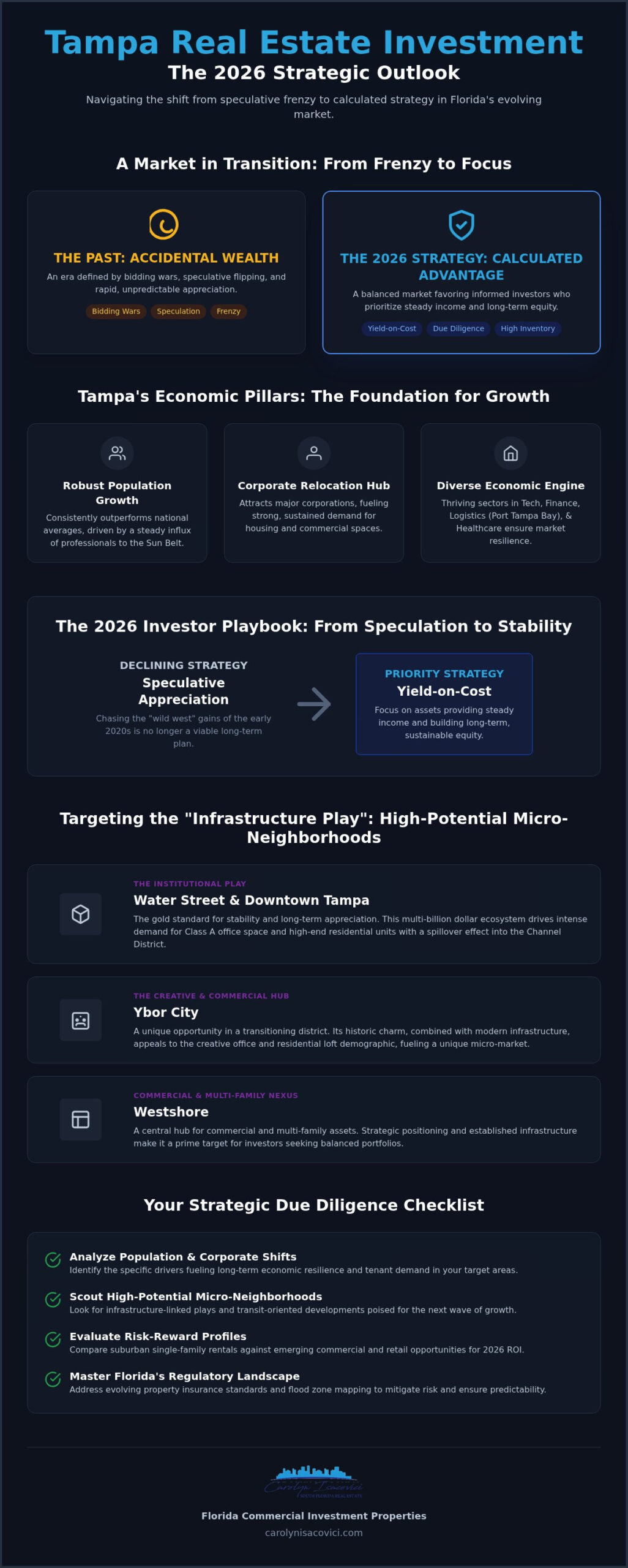
    The era of accidental wealth in Florida real estate has transitioned into an era of the calculated strategist. You’ve likely noticed that the bidding war frenzy has cooled, replaced by a more balanced market where inventory is at a multi-year peak. It’s understandable to feel cautious as insurance costs average around $5,341 and new tax laws loom on the horizon. However, this stabilization is exactly what makes the current selection of Tampa investment properties for sale so compelling for those who know where to look.

    You’re about to discover why Tampa remains a resilient cornerstone of the Sunshine State and how you can secure high-yield assets in this evolving landscape. We’ll provide a clear framework for evaluating 2026 ROI, analyze the critical shift from residential to commercial demand, and guide you through the micro-neighborhoods poised for the most significant infrastructure growth. By the end of this guide, you’ll have the insight needed to transform market uncertainty into a definitive strategic advantage. Let’s explore how to navigate this new cycle with confidence and precision.

    Key Takeaways

    • Identify the specific population shifts and corporate relocations that continue to fuel Tampa’s long-term economic resilience.
    • Discover how to spot high-potential micro-neighborhoods and infrastructure-linked plays when evaluating Tampa investment properties for sale.
    • Compare the 2026 risk-reward profiles of suburban single-family rentals against emerging commercial and retail opportunities.
    • Develop a robust due diligence checklist that addresses Florida’s evolving property insurance standards and flood zone mapping.
    • Learn why partnering with a seasoned local broker is essential for navigating complex regulations and securing high-value assets.

    The Tampa Real Estate Market in 2026: Why Investors Stay Bullish

    Why does the Tampa-St. Petersburg-Clearwater MSA continue to attract significant capital? It’s the people. By 2026, population growth in this region has consistently outperformed national averages, driven by a steady influx of professionals seeking the Florida Sun Belt’s lifestyle and economic advantages. This isn’t just a temporary surge; it’s a structural shift. For a comprehensive Tampa, Florida overview, one can see how the city’s historical evolution and geographic advantages support this modern expansion. As more corporations relocate their headquarters to the region, the demand for high-quality housing and commercial spaces remains robust.

    Does the mention of insurance costs or climate resilience cause hesitation? It’s a valid question. However, the 2026 market has matured. Legislative reforms and enhanced building codes have created a more predictable environment for sophisticated investors. We view these factors not as roadblocks, but as necessary variables to be managed within a Strategic Florida Real Estate Portfolio Building plan. When you look at the available Tampa investment properties for sale through a lens of long-term stability, the opportunity becomes clear. The “calm expert” sees these market adjustments as a filter that clears out speculative noise, leaving high-value assets for those with a professional partner.

    Economic Drivers and Job Market Expansion

    Downtown Tampa has transformed into a vibrant hub for tech and finance, attracting a younger, high-earning demographic. This migration fuels the need for both residential and retail assets in the urban core. Meanwhile, the Port of Tampa Bay continues to be a massive engine for industrial property demand, serving as a gateway for international trade and logistics. When you combine this with the rock-solid stability of the healthcare and education sectors, you get an economy that doesn’t just survive cycles; it thrives through them. These diverse employment sectors ensure that tenant demand remains high across multiple asset classes.

    The 2026 Forecast: Appreciation vs. Cash Flow

    The “wild west” appreciation of the early 2020s has settled into a phase of sustainable, predictable growth. In 2026, successful investors prioritize “Yield-on-Cost,” looking for assets that provide steady income while building long-term equity. This shift away from speculative flipping toward disciplined acquisition is a sign of a healthy, adult market. It’s about finding the right Tampa investment properties for sale that align with your specific financial goals rather than chasing a trend. The 2026 Tampa market represents a balanced opportunity where investors can capture reliable cash flow today while positioning themselves for meaningful equity gains tomorrow.

    Targeting the Best Neighborhoods for Tampa Investment Properties

    How do you choose between a high-traffic urban core and a quiet suburban pocket? In 2026, the answer lies in following the “Infrastructure Play.” Smart investors are looking beyond current aesthetics to identify where Tampa’s economic development initiatives are concentrating capital. This strategy focuses on transit-oriented developments and mixed-use hubs that create their own demand. While some areas have reached saturation, emerging micro-markets offer a more attractive entry point for those seeking Tampa investment properties for sale. By moving toward areas with planned transit expansions, you position your portfolio to benefit from the next wave of appreciation.

    Water Street and Downtown Tampa: The Institutional Play

    The multi-billion dollar Water Street development has redefined the city’s skyline. It’s not just about new buildings; it’s about the creation of an entirely new ecosystem. This institutional-grade project has driven intense demand for high-end residential units and Class A office spaces. We’re seeing a significant spillover effect into the Channel District, where older industrial footprints are being reimagined as luxury dwellings. If you’re looking for stability and long-term appreciation, this urban core remains the gold standard for institutional plays. The demand for walkable, high-amenity living remains a primary driver for values in this district.

    Ybor City and Westshore: Commercial and Multi-Family Hubs

    Ybor City offers a different flavor of opportunity. Its transition into a creative office and residential loft destination is well underway. The historic charm, combined with modern infrastructure, appeals to a demographic that rejects the traditional corporate cubicle. It’s a unique micro-market where heritage meets high-tech demand. Conversely, Westshore remains the largest office submarket in Florida. Its proximity to the airport and major thoroughfares makes it a powerhouse for commercial demand. When evaluating the density here, many investors draw parallels to the multi-family property for sale Miami market, noticing how Westshore is evolving into a true live-work-play district. This concentration of employment makes Westshore a reliable target for multi-family acquisitions.

    Identifying these nuances is where professional guidance becomes invaluable. If you’re ready to explore these specific micro-markets, it’s helpful to consult with a local broker who understands the block-by-block dynamics of the region. Finding the right Tampa investment properties for sale requires more than just looking at a map; it requires an understanding of where the city is headed over the next decade. Historic districts, once overlooked, are now becoming high-yield opportunities for those willing to navigate the preservation requirements in exchange for unique, high-demand assets.

    Commercial vs. Residential: Choosing Your Tampa Asset Class

    Which asset class offers the best protection against market shifts? In 2026, the choice between commercial and residential assets isn’t just about the numbers; it’s about your personal risk tolerance and management style. Retail and office spaces in Tampa have seen a revitalization as mixed-use developments become the norm. While these commercial assets often offer higher cap rates, they also require a deeper understanding of lease structures and tenant credit. Conversely, the single-family rental (SFR) market in suburban Tampa remains incredibly resilient, providing a steady floor for investors who prioritize consistent cash flow. For a deeper dive into these nuances, explore our Commercial vs Residential Investment Florida guide.

    When you evaluate Tampa investment properties for sale, you’ll find that residential multi-family units currently offer a more accessible entry point for many, though cap rates may be slightly more compressed compared to specialized retail. The key is to match the asset to your portfolio’s specific needs. Are you looking for the hands-off nature of a NNN commercial lease, or do you prefer the high demand of the residential sector? Both paths lead to success when navigated with a clear strategy.

    The Rise of Industrial and Flex Space

    Have you considered the “last-mile” delivery boom? The I-4 corridor has become a primary artery for logistics, creating a surge in demand for industrial flex space. Small-bay industrial properties are particularly attractive in 2026 because they offer portfolio diversification without the heavy capital requirements of massive warehouses. Certain Tampa industrial zones also offer specific zoning advantages that allow for higher density or specialized usage. This niche remains a favorite for those looking to capture the growth of e-commerce and local service businesses.

    Residential Investment: New Construction vs. Value-Add

    Is it better to buy new or renovate? For many, the appeal of buying new construction homes in Florida lies in the lower maintenance costs and modern building standards that help mitigate insurance premiums. However, the value-add strategy is still thriving in established neighborhoods like Seminole Heights. Here, investors can find older homes with character and upgrade them to meet the demands of modern tenants. When looking at Tampa investment properties for sale, you must decide between the reliable, long-term rental model or the potentially higher-yielding short-term vacation stay. Each requires a different operational framework, but both benefit from Tampa’s consistent population growth.

    Tampa Investment Properties: 2026 Strategic Investor Guide

    Does the technical side of a Florida closing feel overwhelming? It doesn’t have to. While the state’s regulatory landscape is unique, approaching it with a methodical mindset transforms potential hurdles into manageable steps. Success in 2026 requires a deep understanding of how to evaluate investment property Florida metrics, particularly when assessing Tampa investment properties for sale. We prioritize clarity over confusion, ensuring you understand exactly how flood zone mapping and insurance premiums impact your bottom line. With the average annual cost of homeowners insurance in Tampa reaching approximately $5,341 as of August 2026, verifying elevation certificates and wind mitigation reports isn’t just a suggestion; it’s a financial necessity.

    The local tax environment also requires a steady hand. While the “Save Our Homes” assessment cap provides significant relief for primary residents, investors must look toward the November 2026 ballot. A proposed constitutional amendment (HJR 1F) could potentially reduce the maximum annual assessment increase on non-homestead properties from 10% to 5%. Staying ahead of these legislative shifts allows you to project your long-term carrying costs with far greater accuracy. We help you navigate these details so you can focus on the growth potential of your portfolio.

    The Financial Deep Dive: Beyond the Cap Rate

    Calculating your Net Operating Income (NOI) requires realistic 2026 expense ratios that account for modern service costs and updated property tax millage rates. In this market, professional property management is your greatest ally in protecting ROI, as they handle the day-to-day complexities that out-of-state owners might miss. It’s also vital to remember that utilizing a 1031 Exchange is an essential strategy for deferring capital gains taxes and scaling your holdings effectively. By looking beyond the initial cap rate, you ensure the asset remains a high-performer throughout the entire holding period.

    Local Regulations and Zoning Laws

    Tampa maintains specific rules regarding short-term rentals, especially in residential neighborhoods where AirBnB activity is closely monitored. Understanding these local ordinances prevents costly compliance issues after you’ve already committed capital. For those exploring commercial land or industrial assets, environmental assessments are non-negotiable to uncover any historical site concerns. Working with a local expert is often the only way to uncover off-market opportunities that never reach public portals. If you are ready to move forward, you can secure your next acquisition by leveraging our deep network of local connections and regulatory insights.

    Partnering for Success in the Florida Market

    How do you move from analysis to acquisition? The final step in any successful investment journey is choosing the right professional partner. In a market as nuanced as Tampa’s, the difference between a standard transaction and a high-yield acquisition often comes down to the quality of the brokerage. Carolyn Isacovici specializes in transforming market uncertainty into clear opportunity, providing the steady hand needed to navigate 2026’s unique conditions. Whether you’re targeting residential portfolios or looking for a foothold in the commercial sector, having an expert who manages the end-to-end sales process ensures that no detail is overlooked. It’s also helpful to view these opportunities within the broader context of the state. For instance, comparing local shifts against Miami real estate market trends can provide a valuable benchmark for timing your entry into different Florida submarkets.

    Securing the right Tampa investment properties for sale requires more than just a search engine; it requires a navigator who understands the block-by-block evolution of the city. We provide comprehensive support for both commercial and residential transactions, ensuring that your capital is placed in assets with the highest potential for resilience. By taking a long-term view of the Florida market, we help you build a portfolio that isn’t just surviving the current cycle but is positioned to lead the next one.

    The Advantage of a Seasoned Florida Broker

    Why settle for a purely transactional relationship? An advisory approach goes beyond simply showing you Tampa investment properties for sale; it involves deep-tier strategic planning and risk mitigation. Since 2006, our firm has maintained a focused presence in Florida’s most competitive markets, helping investors identify high-value holdings that others might miss. This longevity means we’ve seen various cycles and remain unruffled by temporary market fluctuations. We don’t just sell property; we help build legacies by focusing on high-yield investment property identification and navigating the complex regulations that define the Sunshine State.

    Next Steps: Securing Your Tampa Asset

    Ready to take the next step? The path forward begins with a clear, professional portfolio review or a targeted property search. In the 2026 market, timing is everything, but speed should never come at the expense of professional guidance. We provide the structural support required to move from the “what if” phase to a finalized closing with confidence. Tampa’s future is exceptionally bright for the informed investor who acts with precision. By aligning yourself with a partner who understands the local landscape, you ensure that your capital is positioned for maximum resilience and growth. Let’s transform your 2026 goals into a tangible, high-performing reality.

    Capitalizing on the Tampa Advantage

    Is your portfolio ready for the next decade of Florida growth? Success in 2026 belongs to those who look past the noise and focus on the structural strengths of the region. Modern infrastructure plays and a disciplined approach to due diligence help mitigate risks like rising insurance costs. Whether you’re exploring commercial flex space or residential multi-family units, the current selection of Tampa investment properties for sale offers a resilient foundation for long-term wealth. You don’t have to navigate these complexities alone.

    Choosing the right assets requires a navigator who understands the block-by-block evolution of this city. Carolyn Isacovici has specialized in high-value Florida assets since 2006, providing a steady, advisory hand across both commercial and residential investment brokerage. We transform complex market conditions into clear, actionable strategies for our partners. Consult with Carolyn Isacovici to find your next Tampa investment property today. The future of the Sun Belt is bright, and with professional guidance, you can claim your place in its success with complete confidence.

    Frequently Asked Questions

    Is Tampa a good place for real estate investment in 2026?

    Tampa remains a premier destination for capital in 2026 because of its robust job market and steady population influx. While the frantic bidding wars of the past have subsided, they’ve been replaced by a healthy, balanced market with record inventory levels. This stability allows you to evaluate Tampa investment properties for sale with much greater precision. It’s an ideal environment for investors who prioritize long-term equity growth over short-term speculation.

    What are the best neighborhoods in Tampa for rental properties?

    Identifying the right neighborhood depends on your specific asset class. Water Street and the Channel District are the gold standards for high-end urban living and institutional-grade office space. If you’re seeking character and value-add potential, Seminole Heights and Ybor City offer unique residential and creative flex opportunities. Westshore remains a powerhouse for multi-family demand due to its status as a massive employment hub. Each area provides a distinct path to achieving your ROI goals.

    How do Florida insurance costs affect Tampa investment ROI?

    Insurance is a significant variable in any Florida pro forma, with average annual premiums in Tampa reaching $5,341 as of August 2026. These costs directly impact your net operating income, so they must be factored into your initial due diligence. We recommend looking at newer construction or properties with updated wind mitigation features to help stabilize these expenses. A calm, calculated approach to these carrying costs ensures your high-value holdings remain profitable over the long term.

    Should I buy commercial or residential property in Tampa?

    Both asset classes offer unique advantages in the 2026 landscape. Residential properties, particularly single-family rentals in suburban pockets, provide incredible resilience and consistent tenant demand. On the other hand, commercial assets like small-bay industrial or retail flex space can offer higher yields and more hands-off management through NNN leases. Your choice should align with your management capacity and your desire for either steady cash flow or significant long-term appreciation.

    What is the average cap rate for Tampa investment properties?

    Cap rates in Tampa have stabilized as the market moved away from the extreme compression seen in previous years. While residential multi-family units often see more competitive pricing, industrial and specialized retail assets typically offer slightly higher yields to account for their different risk profiles. It’s essential to look beyond the top-line percentage and evaluate the quality of the underlying asset and the strength of the local submarket’s infrastructure to ensure sustainable returns.

    How does Tampa’s growth compare to Miami for investors?

    Tampa and Miami both serve as critical pillars of a strategic Florida real estate portfolio, but they offer different entry points. While Miami remains a global hub for institutional capital and luxury density, Tampa provides a high-growth alternative with a focus on domestic migration and corporate relocation. Many investors use Miami’s established trends as a benchmark to identify emerging opportunities in Tampa’s high-value micro-neighborhoods before they reach full market maturity.

    What are the rules for short-term rentals in Tampa?

    Short-term rental regulations in Tampa are governed by specific city ordinances that vary depending on the zoning of the property. It’s vital to verify local rules and any Homeowner Association restrictions before acquiring Tampa investment properties for sale intended for vacation use. As of July 1, 2026, new state rules also require HOAs to provide faster notice of violations, so staying compliant is more important than ever for maintaining a smooth and profitable operation.

    Can I invest in Tampa new construction for high yields?

    Investing in new construction is a sophisticated play for those looking to minimize maintenance and insurance hurdles. These properties often attract high-quality tenants and benefit from the latest building codes, which can lead to better financing terms and lower operating costs. While the initial entry price might be higher, the reduced capital expenditure over the first decade often results in a very attractive yield-on-cost for the patient, strategic investor who values asset longevity.

  • Miami Warehouse Sale: 2026 Guide to Industrial Assets

    Miami Warehouse Sale: 2026 Guide to Industrial Assets

    What if the most significant asset in your 2026 portfolio isn’t a high-rise office, but a strategic distribution hub positioned perfectly for the last-mile economy? It’s a question many investors are asking as they look at a landscape where industrial space has become the bedrock of regional commerce. You likely feel the pressure of a tightening market, where finding a quality Miami warehouse for sale often feels like searching for a needle in a very expensive haystack. With small-bay vacancy rates hovering at a lean 4.2 percent, the frustration of rising land costs and complex zoning regulations is a reality we all recognize.

    There’s a path through this complexity. We’re here to provide the strategic framework you need to identify and secure high-yield warehouse opportunities in this competitive environment. By the end of this guide, you’ll understand which sub-markets are currently offering the most attractive cap rates and how to manage the specific environmental hurdles of Miami-Dade. We will explore the shift toward modern Class-A facilities and the essential steps to partnering with experts who can grant you access to the off-market inventory that rarely hits the public listing sites.

    Key Takeaways

    • Understand the evolution of Miami’s industrial sector and why these assets now serve as the primary drivers of regional ROI.
    • Navigate the nuances of different asset classes, from versatile flex spaces to high-demand last-mile delivery hubs.
    • Pinpoint high-yield corridors like Airport West and Hialeah to refine your search for a Miami warehouse for sale in 2026.
    • Secure your investment by mastering the critical due diligence steps required to clear environmental and zoning hurdles in Florida.
    • Gain a strategic advantage by learning how professional brokerage unlocks off-market inventory that isn’t available to the general public.

    The 2026 Miami Industrial Landscape: Why Warehouses Are the New Gold

    Miami’s identity has undergone a profound transformation. While it remains a premier global destination for travel, the true engine of the city’s economy has shifted toward the concrete and steel of industrial corridors. Why has this happened? The answer lies in the city’s unique geography. It serves as the primary gateway between the Americas and the global market, turning industrial assets into “gold” for savvy investors who recognize that land is finite but demand is not.

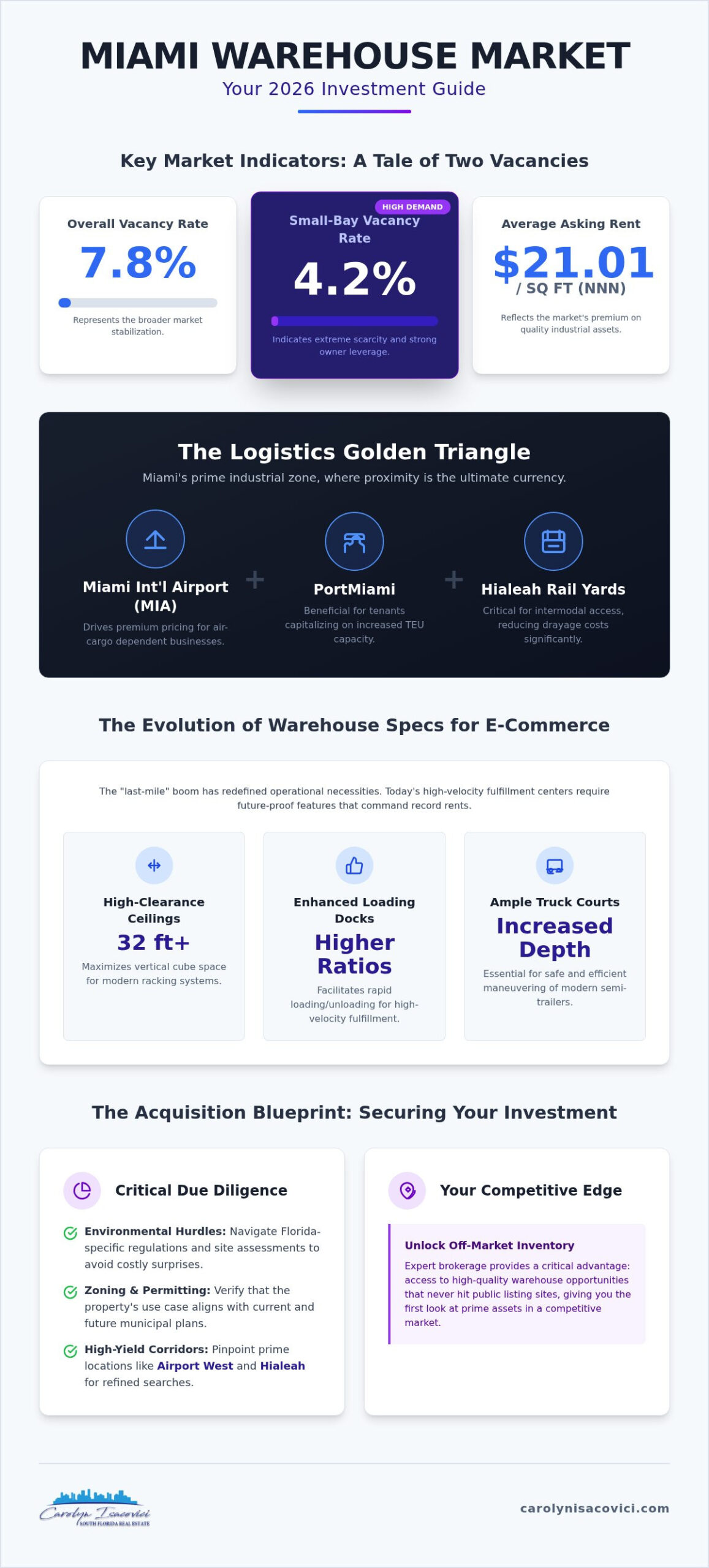
    In 2026, the data tells a story of stabilization and strength. Despite broader economic shifts, the industrial sector remains Florida’s most resilient asset class. The average asking rent has climbed to $21.01 per square foot (NNN) as of the third quarter, reflecting a market that rewards quality. Finding a Miami warehouse for sale requires a nuanced understanding of these metrics. While the overall vacancy rate sits at 7.8 percent, the real story is in the small-bay market, where vacancy is a remarkably tight 4.2 percent. This scarcity drives consistent value for owners and keeps competition high for prime assets.

    The PortMiami and MIA Connection

    Proximity is the ultimate currency in Miami real estate. Properties located near Miami International Airport (MIA) or PortMiami command a significant premium because they minimize the time and cost of moving goods. Speed is everything in 2026. Intermodal connectivity allows businesses to shift cargo seamlessly from ship to rail to air, bypassing the congestion that slows down less strategic locations. The Logistics Golden Triangle is the prime industrial zone bounded by PortMiami, Miami International Airport, and the Hialeah rail yards.

    • MIA Proximity: Dictates higher price-per-square-foot due to air-cargo reliance.
    • Port-Adjacent Assets: Benefit from the recent PortMiami expansions and increased TEU (twenty-foot equivalent unit) capacity.
    • Intermodal Access: Reduces drayage costs, making these properties highly attractive to institutional tenants.

    E-commerce and the 2026 Supply Chain

    The “last-mile” boom has redefined what tenants need. It isn’t just about storage anymore; it’s about high-velocity fulfillment. If you are exploring what is a warehouse in the modern sense, you’ll find that today’s facilities are sophisticated tech hubs. E-commerce tenants are willing to pay record rents for modern specs that allow them to fulfill orders in hours rather than days. When you evaluate a Miami warehouse for sale, look for features that future-proof the investment.

    Modern fulfillment requires high-clearance ceilings, often 32 feet or higher, to maximize vertical cube space. Enhanced loading dock ratios and ample truck court depths are no longer luxuries; they’re operational necessities. Investors who secure properties with these modern specifications are positioning themselves at the center of a permanent shift in consumer behavior, ensuring their assets remain in high demand regardless of broader market fluctuations.

    Decoding Warehouse Types: From Flex Space to Last-Mile Distribution

    Choosing the right property requires more than just looking at square footage. It’s about matching the building’s physical DNA to the tenant’s operational needs. Are you looking for a stable, multi-tenant property or a high-velocity fulfillment center? According to recent Miami industrial market data, the diversity of assets in South Florida allows for a tailored approach to risk and reward. Understanding these distinctions is the first step toward securing a high-value Miami warehouse for sale that aligns with your long-term strategy.

    Flex Industrial: The Versatile Choice

    Flex space is the chameleon of the industrial world. These properties typically feature a higher ratio of office or showroom space compared to traditional warehouses, often ranging from 25 percent to 50 percent office build-out. Why is this attractive? Small-to-medium businesses drive this demand. They need a professional front-facing office combined with functional back-end storage. In mixed-use zoning areas, flex properties often command higher rents per square foot because they cater to a broader range of service-based businesses, from specialized tech firms to boutique distributors.

    Distribution and Logistics Hubs

    For those targeting institutional-grade investments, distribution hubs are the gold standard. These facilities are built for speed and volume. In the 2026 market, Class A assets are defined by their efficiency. You’ll want to look for 32-foot clear heights, ESFR (Early Suppression, Fast Response) sprinkler systems, and significant truck court depths. Trailer parking is another critical factor. As logistics companies face tighter delivery windows, the ability to stage trailers on-site becomes a massive competitive advantage.

    While Class A properties offer the newest tech, Class B assets shouldn’t be overlooked. These older buildings often sit in land-locked infill locations closer to the urban core. They might have lower ceilings, but their proximity to the consumer base can lead to superior cap rate optimization for investors who value location over modern aesthetics. Finding the right balance between building age and location is where many investors find their greatest success.

    Don’t forget the specialized niches. Cold storage remains a high-barrier, high-reward sector in South Florida, driven by our proximity to international food supply chains. It’s a complex niche, but the returns often reflect the specialized nature of the equipment. Whether you’re interested in a specialized facility or a standard bay, having an advisor who understands these operational nuances is essential. You can explore our current investment property sales to see how these different asset types perform in the current market landscape.

    Location Strategy: Mapping Miami’s High-Yield Industrial Corridors

    Success in commercial real estate is often a matter of geography. In Miami, the “best” location depends entirely on your operational goals. Are you prioritizing immediate access to international cargo, or is a deep local labor pool your main concern? As you evaluate a Miami warehouse for sale, it’s helpful to view the map through the lens of specialized corridors. Each area offers a unique balance of accessibility, zoning flexibility, and long-term value.

    Airport West and Doral: The Premium Choice

    Doral remains the crown jewel of the South Florida industrial market. It isn’t just about proximity to the airport; it’s about the ecosystem. This area hosts a high concentration of corporate headquarters and international trade firms, creating a synergy that supports consistently high property valuations. While entry prices here are among the highest in the county, the stability of the tenant base provides a reassuring layer of security. Investors in the Airport West corridor are paying for prestige and a location that is essentially irreplaceable in the global supply chain.

    Medley and Hialeah: The Industrial Workhorses

    If Doral is the front office, Medley and Hialeah are the engine room. Medley is particularly valuable for its heavy industrial zoning, which allows for specialized operations that are restricted in other sub-markets. This flexibility makes it a magnet for manufacturing and recycling firms. Hialeah offers a different advantage: a massive, skilled labor pool and historical significance as a hub for local production. Both areas benefit from exceptional connectivity to the Palmetto Expressway and Florida’s Turnpike, ensuring that goods can move north or south with minimal friction.

    We are also seeing a strategic shift toward emerging hubs. Opa-locka and North Miami are attracting attention as urban infill opportunities become scarce in the traditional core. These areas often offer more competitive entry points while still providing the “last-mile” proximity that e-commerce tenants crave. For those with a longer investment horizon, the South Dade expansion is a frontier worth watching. This region offers something increasingly rare in Miami-Dade: available land for larger footprints. While it requires a visionary approach, the ongoing infrastructure improvements suggest these southern zones will be essential links in the 2026 logistics network. Securing a Miami warehouse for sale in these growth corridors can be a brilliant move for those focused on significant capital appreciation.

    Miami Warehouse Sale: 2026 Guide to Industrial Assets

    The Acquisition Blueprint: Due Diligence and Market Navigation

    Securing a Miami warehouse for sale is a significant milestone, but the path to a successful closing is paved with meticulous verification. How do you transform a promising listing into a secure, high-performing asset? It starts with a disciplined approach to due diligence that looks far beyond the surface of the building. You aren’t just buying square footage; you’re acquiring a complex set of legal permissions and physical capabilities that must align with your investment goals.

    Beyond the paperwork, the physical integrity of the asset is paramount. Does the roof have a remaining life of at least ten years? Are the floor slabs thick enough to support the heavy racking systems modern tenants require? Even the electrical capacity can be a deal-breaker if a tenant plans to implement advanced automation or cold storage. These physical attributes aren’t just maintenance items; they’re the foundation of your asset’s marketability and long-term value.

    Environmental and Zoning Hurdle

    Environmental assessments are your first line of defense, especially in Miami’s older industrial corridors where legacy soil contamination can be a hidden liability. A Phase I assessment is standard, but don’t be surprised if the results necessitate a Phase II to ensure the ground beneath your feet is as clean as the deal itself. Simultaneously, you must decipher Miami-Dade County’s specific zoning codes. Whether it’s IU-1 for light industrial use or the more flexible IU-3 for unlimited manufacturing, the code determines what your tenants can actually do on-site. The highest and best use of a Miami warehouse is the legally permissible, physically possible, and financially feasible use that results in the highest property value.

    Financial Due Diligence for 2026

    Financial modeling in 2026 requires a steady hand and a sharp eye for detail. With average industrial cap rates sitting at 5.9 percent as of the third quarter, the margin for error has tightened. You must account for the local tax environment, including a total millage rate of approximately 17.59 mills, and the rising costs of property insurance. These factors directly impact your net operating income and your ultimate yield. To master these calculations, you can explore our guide on how to evaluate investment property Florida.

    Navigating these complexities is easier when you have a partner who understands the local nuances of the South Florida market. If you’re ready to move from analysis to action, we invite you to review our current investment property sales to find an asset that meets your criteria.

    Securing Your Investment: Why Expert Brokerage is Your Competitive Edge

    Why do some investors always seem to find the right property while others are left browsing outdated listings? Finding a Miami warehouse for sale in 2026 is a task that requires more than just an internet connection; it requires a network. In a climate where vacancy rates for small-bay warehouses are at a razor-thin 4.2 percent, the traditional route of searching public databases often leads to a dead end. This is where specialized brokerage becomes your most powerful tool. A seasoned guide doesn’t just find buildings. They navigate the unwritten rules of Miami-Dade real estate, from understanding the specific motivations of local sellers to anticipating the legal shifts in Florida’s 2026 commercial framework.

    Managing the transition from offer to close is a complex dance of logistics and legalities. A specialized broker acts as the steady hand that keeps the deal on track when environmental hurdles or zoning nuances arise. They ensure that your acquisition isn’t just a transaction, but a strategic step toward building a resilient industrial portfolio. By partnering with a firm that views the market through a lens of long-term value, you transform the stress of a competitive market into a sense of clear opportunity.

    The Value of Local Relationships

    The most coveted deals in the 2026 market often happen behind closed doors. Institutional buyers and private family offices frequently prefer quiet transactions to avoid the noise of a public bidding war. By the time a property appears on major listing sites, it has often been picked over by those with early access. Carolyn Isacovici’s approach focuses on these high-value property holdings, leveraging deep-rooted connections to secure assets before they are widely known. This insider perspective is essential for identifying new construction or pre-leased facilities that offer immediate, reliable cash flow.

    Your Next Steps in the Miami Market

    Success starts with clarity. You need to define your investment criteria early, determining your preferred scale, target sub-markets like Doral or Medley, and a realistic budget for 2026 valuations. Timing is everything. When an opportunity for a Miami warehouse for sale arises, the ability to execute quickly separates the successful owner from the spectator. Planning for the long term is just as vital as the initial purchase. You can begin crafting your roadmap by reading about Florida real estate portfolio building to ensure every acquisition serves a larger strategic purpose.

    Positioning Your Portfolio for the Next Logistics Cycle

    The 2026 market offers a unique window for those who approach industrial assets with a strategist’s mindset. Success in this landscape isn’t about chasing every listing; it’s about understanding the synergy between modern specs and high-yield corridors. By prioritizing rigorous due diligence and focusing on the “last-mile” potential of infill locations, you turn market scarcity into a distinct advantage. Identifying the right Miami warehouse for sale requires a blend of data-driven analysis and the local relationships that reveal off-market opportunities.

    Timing and insight are your greatest allies. We specialize in high-yield Florida commercial investments, providing the expert guidance and end-to-end brokerage support you need to secure high-value property holdings. Whether you’re expanding an existing footprint or entering the Miami market for the first time, our firm is here to ensure your transaction is smooth and strategically sound. Secure your Miami industrial asset with Carolyn Isacovici and move forward with confidence. The future of South Florida logistics is bright, and your place within it is waiting.

    Frequently Asked Questions

    What is the average price per square foot for a Miami warehouse in 2026?

    The average sale price for industrial space in Miami-Dade County reached approximately $280 per square foot as of the third quarter of 2026. This figure acts as a general benchmark for the market. Specific prices for a Miami warehouse for sale can fluctuate based on proximity to the airport or port. Modern Class-A facilities typically command a premium, while older infill properties might offer a more accessible entry point for investors.

    Which Miami neighborhoods are best for last-mile distribution centers?

    Doral and the Airport West corridor remain the premier choices for last-mile distribution due to their immediate proximity to Miami International Airport. Hialeah and Medley are also highly effective hubs, offering exceptional access to major arteries like the Palmetto Expressway. For those seeking emerging value, Opa-locka and North Miami provide strategic urban infill opportunities. These locations allow businesses to reach dense consumer populations quickly, which is the primary goal of any last-mile strategy.

    What are the most common zoning codes for industrial property in Miami-Dade?

    Industrial operations in Miami-Dade are primarily governed by IU-1, IU-2, and IU-3 zoning codes. IU-1, or Light Industrial, is the most common designation, accommodating a wide range of wholesale and distribution activities. Understanding these codes is vital because they dictate everything from allowable noise levels to the types of materials stored on-site. We recommend verifying the specific land-use regulations for any property to ensure it supports your intended business operations without legal friction.

    How do I check for environmental issues before buying a Florida warehouse?

    Performing a Phase I Environmental Site Assessment (ESA) is the standard first step to identify potential contamination or historical liabilities. If the Phase I report suggests concerns, a Phase II assessment involving soil or groundwater sampling becomes necessary. In Florida’s industrial zones, these checks are essential for protecting your investment capital. Working with a specialized broker ensures you have the right consultants to navigate these technical evaluations before your closing date arrives.

    Are there tax incentives for buying commercial property in Miami?

    Florida’s lack of a state personal income tax remains a significant indirect incentive for individual investors and business owners. Certain areas within Miami-Dade may also qualify for federal benefits if they are located within designated growth zones. While the 2025 millage rate is approximately 17.59 mills for taxes due in 2026, we advise consulting with a tax professional. They can help you explore specific local credits or exemptions that might apply to your commercial property acquisition.

    What is the typical cap rate for industrial real estate in South Florida right now?

    The average cap rate for industrial real estate in the Miami market is approximately 5.9 percent as of late 2026. While this represents a stabilization from previous years, individual rates vary significantly by asset class. Class-A distribution centers in prime locations may see lower rates due to their stability. Finding a Miami warehouse for sale with an optimal cap rate requires balancing the age of the building against its potential for future rent growth.

    Can I buy a warehouse in Miami for a 1031 exchange?

    Industrial properties are excellent candidates for a 1031 exchange, allowing you to defer capital gains taxes by reinvesting proceeds into a like-kind asset. Many investors transition from residential or office holdings into the industrial sector to capture higher yields and stable tenant profiles. Because the 1031 process involves strict timelines, partnering with an experienced brokerage firm is essential. This helps you identify and secure a suitable replacement property within the required 45-day identification period.

  • Miami Mixed-Use Property: 2026 Investor Strategic Guide

    Miami Mixed-Use Property: 2026 Investor Strategic Guide

    Could the very regulations that seem to complicate the South Florida market actually be your greatest competitive advantage this year? It’s a question many seasoned investors are asking as they scan the latest listings for a Miami mixed-use property for sale. You’ve likely felt the weight of escalating property insurance premiums or felt a bit of hesitation when looking at the complex Miami-Dade zoning updates. It’s perfectly natural to feel a sense of caution when older inventory carries the risk of hidden structural liabilities, but these challenges often hide the most rewarding opportunities.

    We believe that clarity is the best antidote to uncertainty. This guide is designed to transform those market pressures into a clear, actionable strategy for success. We’ll provide a robust financial modeling framework that balances commercial yield with residential stability, helping you navigate the 9th Edition of the Florida Building Code and the latest Live Local Act amendments with confidence. You’ll gain a reliable roadmap for due diligence and the insight needed to select neighborhoods with the highest growth velocity. Let’s move past the noise and focus on the strategic wisdom that turns a complex transaction into a legacy asset.

    Key Takeaways

    • Learn how 2026 migration trends are fueling the “Live-Work-Play” demand, creating a stable foundation for hybrid residential and commercial income streams.
    • Master the analytical frameworks needed to underwrite deals, focusing on Net Operating Income and the specific cap rate compression currently affecting the Miami market.
    • Navigate neighborhood selection with ease by distinguishing between stable Core assets and high-growth Value-Add opportunities near transit-oriented developments.
    • Secure your investment in any Miami mixed-use property for sale by following a rigorous due diligence checklist that covers 40/50 year recertifications and proactive insurance auditing.
    • Discover how specialized brokerage expertise can help you source off-market deals and transform complex data into a winning acquisition strategy.

    The Strategic Appeal of Miami Mixed-Use Property in 2026

    Why is the demand for a Miami mixed-use property for sale reaching new heights in 2026? It’s simple. The way we live has fundamentally shifted toward convenience and connectivity. Investors are no longer just buying buildings; they’re investing in localized ecosystems. A mixed-use development serves as a sophisticated hybrid asset class, blending the reliable cash flow of residential units with the high-upside potential of commercial storefronts. This combination creates a resilient revenue stream that can weather various market cycles with grace.

    Many investors are shifting their focus toward these assets because they offer a unique hedge against inflation. In a city as dynamic as Miami, where land is a premium commodity, maximizing every square foot isn’t just smart; it’s essential for long-term wealth preservation. By securing a property that serves multiple purposes, you aren’t just collecting rent. You’re providing the infrastructure for the “Live-Work-Play” lifestyle that defines modern South Florida.

    The 2026 Miami Macro-Economic Landscape

    The local economy is thriving. With approximately 9,000 new jobs expected to be added in Miami-Dade County throughout 2026, the influx of professional talent is driving a massive need for integrated spaces. Corporate relocations aren’t just bringing employees; they’re bringing people who want to walk to work and grab coffee on the ground floor of their own building. Current Miami real estate market trends show a distinct favor toward high-density assets that maximize land utility.

    Demographic shifts are equally compelling. We’re seeing a rise in “urban explorers” across all age groups who prioritize walkability over long commutes. This shift is supported by recent legislative changes, such as the 2026 amendments to the Live Local Act, which encourage denser development. It’s a strategic moment for those looking to capitalize on a 0.7% employment increase and a growing preference for vibrant, urban environments.

    Diversification: The Mixed-Use Advantage

    How do you protect your portfolio against a shifting economy? Diversification is the key. By combining residential units with commercial leases, you significantly mitigate the risk of total vacancy. While residential rents provide a steady, predictable floor, commercial leases often offer longer terms and the potential for higher Florida commercial real estate for sale yields. This balance is at the heart of the commercial vs residential investment Florida debate.

    Mixed-use assets allow you to capture the best of both worlds, offering a recession-resistant buffer that pure-play assets often lack. When the commercial retail sector faces a shift, your residential occupancy keeps the lights on. Conversely, when residential turnover occurs, your long-term commercial tenants provide the stability you need. It’s a thoughtful approach to investment that prioritizes both growth and security.

    Underwriting the Deal: Financial Frameworks for Miami Analysis

    How do you place a precise value on a property that wears two hats? When evaluating a Miami mixed-use property for sale, your analysis begins with Net Operating Income (NOI). This figure represents your total income minus operating expenses, excluding debt service. In 2026, we are seeing a unique phenomenon known as “Miami Compression.” This occurs when high investor demand keeps capitalization rates lower than national averages, reflecting the market’s perceived stability and growth potential. While institutional players might look at a 5% or 6% cap rate, you must ensure your specific deal supports your personal yield requirements.

    Gross Rent Multiplier (GRM) serves as a helpful high-level screening tool. It’s a quick way to compare local listings before diving into a deep-dive audit. However, your Cash-on-Cash return is what truly tells the story of your pocketbook. With commercial mortgage rates in September 2026 ranging from 5.41% to 11.75%, your financing strategy is just as important as the purchase price. Most lenders currently prioritize a Debt-Service Coverage Ratio (DSCR) of at least 1.25x, meaning your property must generate 25% more income than the annual debt payment to qualify for traditional financing.

    Calculating the Commercial-Residential Split

    Valuing a hybrid asset requires a dual-lens approach. You’ll often apply a lower cap rate to the stable residential portion and a slightly higher, risk-adjusted rate to the commercial storefronts. A blended cap rate is the weighted average of the individual capitalization rates applied to the commercial and residential income streams based on their respective contributions to the total property value. Lease durations also play a pivotal role; a five-year commercial lease with a credit tenant provides a different level of security than a month-to-month residential agreement.

    Adjusting for the Florida Factor in 2026

    Successful underwriting requires a realistic look at “soft costs” that are unique to the Sunshine State. When modeling your pro forma for investment property Florida, you must account for the property tax reset. In Miami-Dade County, the average tax rate is approximately 1.94% of the assessed fair market value, and this figure typically jumps significantly after a title transfer. Insurance premiums also require a conservative buffer. We recommend allocating higher maintenance reserves to account for the relentless humidity and salt air, ensuring your asset remains in peak condition. If these numbers feel complex, it may be time to consult with a local expert who can help refine your model.

    Neighborhood Velocity: Where to Target Mixed-Use Acquisitions

    How do you choose the right location when every corner of Miami seems to be buzzing? It’s about understanding “velocity,” which is the speed and direction of a neighborhood’s economic growth. When you’re browsing for a Miami mixed-use property for sale, you must distinguish between Core markets that offer stable, predictable yields and Value-Add markets that offer significant appreciation potential. Location isn’t just a static address; it’s a dynamic factor that dictates your tenant quality and long-term exit strategy.

    Transit-oriented development (TOD) is a primary driver for mixed-use success in 2026. Properties located near Brightline stations or Metrorail hubs are seeing a distinct “transit premium” in their valuations. Why? Because connectivity is the ultimate amenity. This is closely tied to a property’s Walkability Score. In modern Miami, a high walkability rating isn’t just a perk; it’s a measurable metric that directly correlates with higher rent premiums for both retail storefronts and residential apartments. Beyond the city center, we’re seeing high-velocity hubs emerging from Hollywood FL up through the Treasure Coast, where savvy investors are finding more accessible entry points with strong demographic tailwinds.

    The Core Markets: Brickell and Edgewater

    Brickell remains the undisputed “Wall Street of the South.” It’s a low-vacancy environment where demand for luxury residential units perfectly complements the high-end retail and office spaces below. While entry prices are undeniably higher here, the institutional-grade stability is a powerful draw for those prioritizing wealth preservation. By analyzing Miami property appreciation investment data, it’s clear that these core areas provide a reliable floor for your capital. The risk isn’t in the demand; it’s in the competition for limited inventory.

    The Growth Frontier: Little Havana and North Miami

    Are you looking for higher upside? Little Havana and North Miami have become favorites for strategic Florida real estate portfolio building. These neighborhoods are currently navigating the gentrification curve, offering a “sweet spot” for investors who can spot under-managed assets. We often see older mixed-use buildings in these areas that are ripe for modernization. By improving the management and aesthetics of these properties, you can capture the rising tide of these high-velocity neighborhoods before they reach their peak pricing. It’s about timing your entry to match the neighborhood’s evolution.

    Miami Mixed-Use Property: 2026 Investor Strategic Guide

    The 2026 Due Diligence Checklist for Mixed-Use Assets

    What is the true cost of a missed detail during the inspection period? It’s often measured in thousands of dollars of unforeseen repairs or legal hurdles. Precision matters. When you’re evaluating a Miami mixed-use property for sale, your due diligence process must be more than a cursory glance; it needs to be a deep-dive technical audit. We focus on four critical pillars to ensure your transition from prospect to owner is seamless and secure.

    • The 40/50 Year Recertification: For older stock in Miami-Dade, this is non-negotiable. You must verify that the building has passed its structural and electrical inspections, as these requirements have become significantly more stringent following recent legislative updates.
    • Insurance Auditing: Don’t wait. Secure binding quotes before your inspection period ends. With premiums fluctuating, knowing your exact carrying costs is vital for your final pro forma.
    • Zoning and Land Use: Verify the legality of the current mixed-use split. You want to ensure that the residential-to-commercial ratio complies with municipal codes to avoid future enforcement actions.
    • Estoppel Certificates: These are your best friend. They confirm the commercial tenant terms, security deposits, and any “handshake deals” the previous owner might have made, protecting you from post-closing surprises.

    Structural Integrity and Climate Resilience

    In the 2026 Miami market, structural integrity isn’t just a safety metric; it’s the absolute foundation of your asset’s long-term equity. You’ll need to scrutinize elevation certificates and perform a detailed flood zone analysis. The 9th Edition of the Florida Building Code, taking effect at the end of 2026, emphasizes wind resistance and water intrusion protection. Evaluating the cost of future climate-related retrofitting now prevents your capital from being trapped in a building that requires massive, unplanned upgrades later.

    Legal and Regulatory Compliance

    Success requires a clear understanding of the shifting legal landscape. You must navigate Miami’s specific short-term rental (STR) ordinances, which can vary significantly between mixed-use buildings and traditional residential blocks. Furthermore, the 2026 amendments to the Live Local Act have changed the game for density and development potential, often preempting local height restrictions for qualifying projects. Ensuring all investment property due diligence Florida steps are met allows you to buy with a steady hand. If you want to ensure your checklist is bulletproof, you can schedule a due diligence consultation with our team to review the specifics of your potential acquisition.

    Executing Your Miami Mixed-Use Acquisition Strategy

    How do you move from detailed analysis to successful ownership? It’s one thing to identify a Miami mixed-use property for sale; it’s another to navigate the closing process on favorable terms. A specialized broker acts as your strategic engine, translating raw data into a compelling offer that sellers take seriously. In a market where the best assets often move before they hit public portals, local relationships are your greatest currency. We leverage deep-rooted connections to surface off-market opportunities, giving you a head start in a competitive environment.

    Success isn’t a solo sport. You need a 2026 acquisition team that includes specialized lenders, forensic inspectors, and attorneys who understand the nuances of mixed-use contracts. Your broker orchestrates this ensemble, ensuring every piece of the puzzle fits perfectly. When the inspection reveals necessary upgrades, your broker steps in to negotiate repair credits, protecting your capital and ensuring the deal remains financially viable. This level of advocacy ensures that you aren’t just buying a building; you’re securing a sound investment.

    Why a Local Broker is Your Competitive Advantage

    Can an algorithm truly value a hybrid asset? While automated tools like a “Zestimate” provide a generic starting point, they often fail to account for the specific commercial-residential split we discussed earlier. A Broker’s Opinion of Value (BOV) provides a more nuanced, street-level reality. Carolyn Isacovici uses her 20 years of market cycle experience to identify “red flag” listings that others might miss. This seasoned insight is crucial when you’re looking to transition from a single asset to a diversified Florida real estate portfolio. We focus on finding the value that isn’t always visible on a spreadsheet.

    Next Steps for the Serious Investor

    Are you ready to take the next step? The most successful investors in 2026 are those who arrive prepared. This means having your proof of funds ready and your specific investment criteria clearly defined. Whether you’re targeting a stable yield in Brickell or a value-add play in Little Havana, clarity is your best tool. We’re here to help you refine your target list and navigate the complexities of the Miami market with a steady hand. If you’re ready to move forward, we invite you to schedule your 2026 Miami investment strategy session today. Let’s turn your investment goals into a tangible reality.

    Securing Your Future in the Miami Market

    The path to a successful investment in 2026 is paved with both data and local wisdom. We’ve explored how balancing residential stability with commercial upside creates a resilient portfolio, especially when you align your targets with high-velocity neighborhoods like Little Havana or the established corridors of Brickell. Success requires more than just finding a Miami mixed-use property for sale; it demands a rigorous approach to due diligence that accounts for the latest Miami-Dade zoning shifts and structural recertification requirements.

    With over 20 years of experience navigating these complex market cycles, we specialize in high-yield investment brokerage that prioritizes your long-term success. We understand the nuances of the 2026 regulatory landscape and the technical depth required for hybrid assets. Why navigate these complexities alone when you can have a seasoned guide by your side? You can contact Carolyn Isacovici for a custom Miami mixed-use analysis to refine your strategy. Let’s work together to transform today’s market conditions into your next great opportunity. Your vision for a high-performing South Florida portfolio is well within reach.

    Frequently Asked Questions

    What is a good Cap Rate for a Miami mixed-use property in 2026?

    A competitive cap rate for a Miami mixed-use property for sale in 2026 typically ranges between 5% and 6.5% for core assets. While national averages might be higher, Miami’s market compression reflects the high demand and limited inventory in South Florida. Investors should prioritize the debt-service coverage ratio (DSCR) over the cap rate alone. Most lenders currently require a DSCR of at least 1.25x to approve financing in this interest rate environment.

    How do Florida insurance increases affect mixed-use investment analysis?

    Rising insurance premiums are a critical factor in your pro forma analysis. They directly reduce your Net Operating Income (NOI), which can lower the overall valuation of the asset. We recommend securing binding quotes during your inspection period rather than relying on the seller’s historical costs. Factoring in these escalating soft costs ensures your investment remains profitable even as the 9th Edition of the Florida Building Code introduces stricter resilience requirements for all buildings.

    What is the 40-year recertification, and why does it matter for investors?

    This is a mandatory safety inspection for buildings in Miami-Dade that have reached 40 years of age, followed by subsequent 10-year intervals. It ensures the structural and electrical systems are sound. For investors, this matters because failure to comply can lead to massive repair assessments or even building closure. Always verify that a property has a current certificate or a clear path to passing its upcoming inspection before you close the deal on any older asset.

    Can I use a 1031 Exchange to buy mixed-use property in Miami?

    Yes, you can absolutely use a 1031 Exchange to acquire mixed-use assets. This tax-deferred strategy allows you to sell a qualifying investment property and reinvest the proceeds into a like-kind asset, such as a Miami mixed-use property for sale. It’s an excellent way to defer capital gains taxes while upgrading your portfolio. We frequently work with investors to identify suitable replacement properties that meet strict federal timelines and specific high-yield investment goals for 2026.

    Which Miami neighborhoods have the highest mixed-use growth potential?

    Little Havana and North Miami currently show the highest velocity for mixed-use growth. These areas benefit from the 2026 amendments to the Live Local Act, which encourage higher density and affordable housing components. We are also seeing significant interest in Hollywood FL and the Miami River District. These neighborhoods offer a compelling gentrification curve, allowing investors to enter at a lower price point compared to the established core markets of Brickell or Edgewater in 2026.

    Is mixed-use considered commercial or residential real estate in Florida?

    Mixed-use property is generally classified as commercial real estate because it generates income from multiple sources. However, the specific underwriting often splits the asset into residential and commercial components. For tax purposes in Miami-Dade, the residential portion might qualify for certain exemptions if it serves as a primary residence, but the overall asset is valued based on its income-producing potential. It’s a hybrid class that requires a specialized brokerage approach to value correctly and accurately.

    How does the Live Local Act impact existing mixed-use property owners?

    The Live Local Act, specifically the 2026 amendments under House Bill 1389, provides significant advantages for density. It allows owners to bypass certain local zoning restrictions regarding building height and setbacks if they include a specific percentage of workforce housing. This can dramatically increase the development potential of an existing site. It’s a powerful tool for owners looking to expand their footprint or redevelop older stock in high-demand urban corridors throughout South Florida this year.

    What are the typical closing costs for a mixed-use sale in Miami-Dade?

    Typical closing costs for a mixed-use sale range from 1.5% to 3% of the purchase price for the buyer. This includes the Florida documentary stamp tax on the mortgage, which is $0.35 per $100 of the loan amount, and the intangible tax at 2 mills. You should also budget for title insurance, appraisal fees, and environmental surveys. We always provide our clients with a detailed closing cost estimate early in the process to prevent any surprises.

  • Florida Commercial Real Estate for Private Equity Firms: 2026 Investment Outlook

    Florida Commercial Real Estate for Private Equity Firms: 2026 Investment Outlook

    Is the era of the “Miami-only” play officially over? While the glitz of the Brickell skyline remains undeniable, the most sophisticated investors are looking elsewhere to find the alpha that a saturated core can no longer provide. It’s a common concern for fund managers who see the primary markets tightening while insurance premiums and regulatory shifts create a new layer of complexity. You’ve likely noticed that finding institutional-grade stability in Florida commercial real estate for private equity firms now requires a sharper lens than it did just a few years ago.

    We understand that the 2026 market feels like a puzzle of high stakes and high rewards. This guide is designed to help you navigate these changes, from the total repeal of the commercial lease sales tax to the expansive opportunities created by the Live Local Act 4.0. You’ll discover how to identify high-growth secondary markets and access the off-market deals that never hit the public wire. We’ll explore the 2026 yield landscape and the specific sub-markets where your capital can work the hardest, ensuring your portfolio remains both resilient and profitable.

    Key Takeaways

    • Move beyond the crowded Miami core to discover institutional-grade multi-family opportunities in high-growth corridors like Stuart, Jupiter, and Port Saint Lucie.
    • Identify why industrial logistics and multi-family assets remain the primary drivers of yield as the Florida market enters a healthy stabilization phase.
    • Master the nuances of Florida commercial real estate for private equity firms by shifting focus from speculative plays to secure, core-plus assets.
    • Learn how to access the “Quiet Sale” market through local networks, ensuring your firm secures high-value assets before they ever reach public exchanges.
    • Understand how a seasoned local partner transforms complex regulatory and insurance shifts into clear strategic advantages for your institutional portfolio.

    The 2026 Florida Landscape: Why Private Equity is Doubling Down

    Has the Florida gold rush finally cooled? Not exactly. It’s simply matured. We’ve moved past the frantic, often speculative migration surge of the early 2020s and entered a sophisticated stabilization phase. For those managing what private equity real estate is today, this shift represents a strategic move toward sustainable, core-plus wealth preservation. Florida commercial real estate for private equity firms has transitioned into a seasoned market where the noise of the boom has been replaced by the clarity of long-term data and institutional-grade stability.

    Regulatory stability serves as a powerful anchor for 2026. The complete repeal of the state sales tax on commercial rent, which took full effect in October 2025, has significantly improved net operating income across institutional portfolios. When you combine this with the 10% assessment cap on non-homestead properties, the environment for a long-term hold becomes incredibly compelling. A seasoned guide sees market volatility not as a threat, but as a window for strategic acquisition. While others may hesitate due to shifting insurance premiums, the calm expert recognizes that these hurdles often lead to more favorable entry prices for well-capitalized firms.

    Post-Migration Market Dynamics

    What happens when the initial rush subsides? Growth becomes predictable. In 2026, Florida continues to see sustained population increases, though at a more manageable pace that allows infrastructure and housing supply to synchronize. Corporate headquarters are no longer just exploring South Florida; they’re fully operational, which drives consistent demand in the Class A office and industrial sectors. This isn’t a temporary spike but a permanent realignment of the American economic map. The 2026 yield environment represents a definitive maturation cycle for institutional investors seeking stability over volatility.

    The Institutional Shift to Florida

    Why choose Florida over traditional hubs like New York or California? The answer lies in the friction-less business environment and the absence of state income tax. There’s a massive amount of dry powder currently targeting the 2026 market, especially as an estimated $875 billion in commercial debt matures nationwide this year. This creates a unique opportunity for private equity to step in with liquidity and secure high-quality assets. To understand the full scope of these opportunities, consult our 2026 Investor Guide. This is the moment to capitalize on assets that offer both safety and upside, ensuring that Florida commercial real estate for private equity firms remains a top-tier allocation for the coming decade.

    High-Yield Asset Classes for Institutional Portfolios

    Which sectors offer the most resilient returns in this matured market? It’s no longer about chasing any available square footage; it’s about precision. For those managing Florida commercial real estate for private equity firms, the focus has shifted toward essential infrastructure and demographic-driven demand. We see a landscape where the most successful portfolios are built on assets that serve the fundamental needs of a growing, aging, and increasingly affluent population. By aligning capital with these structural shifts, firms can secure the institutional-grade stability that defines the 2026 outlook.

    Industrial and Cold Storage Demand

    Industrial assets continue to be the backbone of the state’s economic engine. The ongoing expansions at PortMiami and Port Everglades have created a ripple effect, keeping industrial cap rates compressed and demand for last-mile logistics at an all-time high. Cold storage, in particular, has emerged as a high-yield “hidden gem” for institutional investors. These facilities require specialized infrastructure that creates high barriers to entry, making them incredibly resilient against oversupply. In 2026, industrial vacancies in South Florida remain well below national averages, providing a reassuring safety net for those deploying significant capital in the logistics space.

    The Multi-Family “Secondary Market” Play

    The narrative of Florida multi-family is moving north. While the Miami core remains a destination for trophy assets, secondary markets like Port Saint Lucie and Vero Beach are frequently outperforming the metropolitan core in terms of year-over-year rent growth. This shift is driven by a workforce seeking a balance between affordability and quality of life. The Build-to-Rent (BTR) model has also matured into a respected commercial asset class, offering the operational efficiency of a traditional multi-family complex with the privacy of single-family living. Mastering how to evaluate investment property metrics in these emerging corridors is the key to unlocking superior risk-adjusted returns.

    Beyond housing and logistics, Medical Office Buildings (MOB) are benefiting from the state’s unique demographic tailwinds. As the population continues to age, these facilities provide long-term, recession-resistant leases that appeal to core-plus strategies. Simultaneously, high-street retail in luxury corridors is experiencing a vibrant resurgence. This isn’t just about shopping; it’s about providing premium physical experiences for a high-net-worth demographic that has permanently relocated to the Sunshine State. If you are looking to refine your acquisition strategy in these sectors, consulting with a local investment specialist can provide the ground-level clarity needed to move forward with confidence.

    Strategic Geography: Beyond Miami to Florida’s Growth Corridors

    While the Florida market remains a primary engine for growth, sophisticated firms are also monitoring global trends in sustainability and regenerative design. Projects like The ARK are at the forefront of this movement, offering a glimpse into how future-proofed communities can be structured to provide both ecological and institutional value.

    Is Miami still the only game in town? While it remains a global magnet for trophy assets, the intense competition has created high barriers to entry that can occasionally compress yields beyond institutional comfort. For those managing Florida commercial real estate for private equity firms, the most compelling opportunities in 2026 are found in the corridors connecting our major hubs. We are seeing a strategic migration of capital toward markets that offer institutional-grade stability without the “Miami premium.” It’s a shift from chasing status to chasing scalable, sustainable growth. This strategic pursuit often leads sophisticated investors to explore international diversification through resources like Keys to Israel.

    Hollywood and Fort Lauderdale have matured into primary targets for firms looking to capture the region’s economic energy. These cities are no longer just alternatives; they are essential components of a diversified South Florida portfolio. The Brightline rail expansion has been a literal engine for value, turning transit-oriented developments into high-performing commercial assets that command premium rents. This connectivity allows firms to benefit from the region’s shared workforce and infrastructure while finding more attractive entry points. For a granular look at how specific neighborhoods are evolving, our guide on Miami Real Estate Market Trends 2026 provides the data necessary for precise capital allocation.

    The Rise of the Treasure Coast

    Why are we seeing a surge of institutional interest in Port Saint Lucie, Stuart, and Fort Pierce? It comes down to the yield spread. Secondary markets in 2026 often offer cap rates that are 50 to 100 basis points higher than the compressed figures found in the Miami core. Private equity firms are moving north because the infrastructure has finally synchronized with the population growth. In places like Jupiter and Stuart, new multi-family developments are meeting a professional demographic that demands quality. When you compare the risk-adjusted returns of these secondary markets against primary hubs, the Treasure Coast emerges as a vital frontier for institutional multi-family and retail portfolios.

    We also advise looking toward Melbourne and the Space Coast. This region has transformed into a tech-driven industrial powerhouse, fueled by aerospace and defense contracts. This creates a unique commercial landscape where industrial assets aren’t just warehouses; they are sophisticated manufacturing hubs with long-term, credit-worthy tenants. By diversifying across these specific growth corridors, institutional investors can build a Florida footprint that balances the prestige of the core with the high-yield potential of the emerging coast.

    Florida Commercial Real Estate for Private Equity Firms: 2026 Investment Outlook

    Why do the most lucrative institutional assets in the Sunshine State seem to trade behind closed doors? The reality is that “Quiet Sales” dominate the high-value landscape. In a market as competitive as Florida, the best assets often change hands before a listing agreement is even signed. For those managing Florida commercial real estate for private equity firms, relying on public exchanges or saturated digital platforms often means looking at “stale” inventory that has already been picked over by local insiders. Accessing true alpha requires a direct line to the source.

    Sourcing Proprietary Deals

    Securing a “first-look” opportunity requires more than capital; it requires a relationship with a broker who is deeply embedded in the local fabric. These seasoned professionals act as gatekeepers to proprietary deal flow, connecting institutional capital with private owners who value discretion over a public auction. Discretionary capital is your strongest lever here. When a local partner knows your firm can move with speed and certainty, you become the first call for off-market opportunities. In 2026, maintaining access to off-market inventory is the primary competitive advantage for private equity firms looking to outpace the broader market.

    2026 Due Diligence Checklist

    Moving from selection to closing requires a modern approach to due diligence. The regulatory environment has evolved, and your checklist must reflect these shifts to ensure long-term stability. Consider the following priorities:

    • Analyze the Live Local Act 4.0: This legislation has transformed zoning, allowing for multifamily density on sites previously reserved for industrial or commercial use.
    • Evaluate Insurance Strategies: The 2026 landscape shows a stabilization of rates for hardened, resilient assets, but verifying the insurability of a specific site remains paramount.
    • Vet Climate Resiliency: Assessing the physical durability and drainage infrastructure of an asset is no longer optional; it’s a core component of institutional-grade due diligence.

    For a deeper dive into structuring these acquisitions, explore our Strategic Portfolio Building Guide. Vetting local operators and sponsors is just as critical as the physical asset. A seasoned guide helps you see past the pro-forma and into the operational reality of the Florida market. If you’re ready to explore exclusive off-market opportunities, connect with our team to discuss your firm’s specific acquisition criteria.

    Scaling Your Florida Footprint with Expert Brokerage

    Can a simple transaction build a legacy? For institutional investors, the answer is rarely. In the complex landscape of Florida commercial real estate for private equity firms, the difference between a standard acquisition and a strategic victory often lies in the depth of your local partnership. We believe that scaling a footprint in the Sunshine State requires more than just a broker who can find a building; it requires a seasoned guide who understands the rhythm of our market cycles. By aligning your firm’s specific mandates with ground-level intelligence, you can transform the inherent uncertainty of a shifting market into a clear, strategic advantage.

    Carolyn Isacovici specializes in facilitating these end-to-end institutional transactions. Whether your team is targeting new construction or established investment property sales, our approach is built on the foundation of your specific investment criteria. We don’t just present deals; we vet them against the backdrop of Florida’s 2026 regulatory and economic landscape. This ensures that every asset you consider meets the high standards of institutional-grade stability your investors expect.

    The Advisory Advantage

    Why does out-of-state capital often struggle to find the right entry point? It’s often a lack of historical context. Moving from transaction-based relationships to strategic partnerships allows your team to leverage 20 years of market cycle experience. This depth of knowledge is what mitigates risk when evaluating assets in emerging corridors like the Treasure Coast or the Space Coast. Local market intelligence isn’t just about knowing what’s for sale; it’s about knowing why an asset is trading and what the neighborhood will look like five years from now. This foresight is the “calm expert” perspective that turns a potentially stressful acquisition into a confident step forward.

    Next Steps for PE Acquisition Teams

    Ready to sharpen your firm’s Florida strategy? The first step is a comprehensive mandate review. This allows us to align our sourcing efforts with your specific risk profile and yield requirements. Once your criteria are established, we can set up custom deal-flow alerts that prioritize the asset classes and geographies we’ve explored in this outlook. By establishing this communication rhythm, your team gains a “first-look” advantage on proprietary opportunities that never reach the public eye.

    • Mandate Review: Define target yields, asset types, and geographic focus.
    • Deal-Flow Integration: Establish a direct line for off-market institutional assets.
    • Operational Vetting: Leverage our local network to evaluate sponsors and operators.

    If your team is looking to expand its reach with confidence, we invite you to reach out for a professional advisory consultation. Let’s work together to ensure your 2026 Florida portfolio is built for long-term institutional-grade stability and superior risk-adjusted returns.

    Securing Your Institutional Legacy in the 2026 Florida Market

    The 2026 landscape isn’t about the frantic chase of the previous decade; it’s about the disciplined pursuit of institutional-grade stability. By looking beyond the Miami core to high-growth corridors like the Treasure Coast and mastering the nuances of the Live Local Act, your firm can capture yields that others overlook. Success in Florida commercial real estate for private equity firms requires a blend of macro-strategy and ground-level intelligence that only comes from navigating multiple market cycles. You don’t have to navigate these complexities alone.

    With over 20 years of Florida market expertise and specialized institutional-grade brokerage, our team provides the localized intelligence you need across Miami, Broward, and the Treasure Coast to move with absolute confidence. It’s time to turn market maturation into your firm’s greatest strategic advantage. Partner with a seasoned Florida CRE guide for your next PE acquisition to ensure your next transaction is backed by the insight and discretion it deserves. The Sunshine State’s next chapter is yours to write, and we’re here to help you lead it.

    Frequently Asked Questions

    Why is Florida commercial real estate attractive to private equity in 2026?

    Pro-business policy and the total repeal of the commercial lease sales tax are primary drivers. Florida has transitioned from a high-growth migration phase to a stable maturation cycle. This provides a predictable environment for long-term holds. The lack of state income tax and steady corporate relocations continue to bolster demand for institutional-grade assets across the state’s major hubs, offering the stability private equity firms prioritize.

    What are the best-performing commercial asset classes in Florida right now?

    Industrial logistics and necessity-based retail are the standout performers in 2026. Industrial vacancy rates in Miami remain well below national averages, while the retail sector is incredibly tight with vacancies around 3.2%. Multi-family also remains a core allocation, specifically in secondary markets where rent growth is outpacing the primary core. These asset classes offer the institutional-grade stability required for modern private equity portfolios.

    How do PE firms access off-market commercial deals in Miami and Fort Lauderdale?

    Accessing “Quiet Sales” requires a deep-rooted local network rather than a digital platform. Many high-value assets in Miami and Fort Lauderdale trade privately before ever reaching a public exchange. By partnering with a seasoned broker who has decades of local experience, firms gain a “first-look” advantage. This relationship-driven approach is the most effective way to secure Florida commercial real estate for private equity firms without facing trophy-asset competition.

    What impact does the 2026 insurance market have on Florida CRE investments?

    The insurance market is entering a phase of stabilization for hardened, resilient assets. While premiums were a source of friction in previous years, 2026 data shows that modern construction and climate-resilient designs are seeing more favorable terms. We advise firms to conduct rigorous site-specific vetting during due diligence. This careful approach transforms a perceived market hurdle into a strategic filter for identifying high-quality, durable holdings.

    Are secondary markets like Port Saint Lucie suitable for institutional capital?

    Yes, markets like Port Saint Lucie and Stuart have matured into prime targets for institutional capital. These regions offer a yield spread that is often 50 to 100 basis points higher than the Miami core. With infrastructure expanding to meet population growth, the Treasure Coast provides the scalability needed for multi-family and industrial mandates. It’s a strategic frontier for firms seeking risk-adjusted returns outside of oversaturated primary markets.

    How do a local Florida broker assist with PE due diligence?

    A local broker acts as a strategic navigator through Florida’s unique regulatory and geographic nuances. We assist by vetting local sponsors, analyzing site-specific insurance trends, and interpreting zoning changes like the Live Local Act. This advisory role goes beyond the transaction. It provides out-of-state acquisition teams with the ground-level clarity needed to validate pro-forma assumptions and ensure long-term portfolio resilience in a complex market.

    What is the “Live Local Act” and how does it affect Florida property investment?

    The Live Local Act 4.0 is a significant zoning incentive that allows for multifamily development on land previously zoned for commercial or industrial use. It prohibits local governments from restricting building heights below the tallest building within a mile in qualifying areas. For private equity firms, this creates immediate value-add opportunities. It allows for the densification of underutilized commercial sites to meet the state’s persistent housing demand.

    How do cap rates in South Florida compare to the national average in 2026?

    South Florida cap rates remain compressed relative to the national average due to high demand and limited supply. In late 2025 and early 2026, multi-family cap rates in Miami hovered around 4.85%, while Fort Lauderdale sat near 4.95%. While these figures reflect a premium, the strong rent growth and tax advantages often result in superior net returns. Florida commercial real estate for private equity firms continues to be a top-tier allocation for capital preservation.

  • Miami Office Space for Sale: 2026 Investor’s Guide

    Miami Office Space for Sale: 2026 Investor’s Guide

    Is the Miami office market finally cooling down, or are we witnessing a permanent shift in how global wealth anchors itself? With average asking rents hitting $70.70 per square foot and leasing activity jumping 45% year over year, it’s easy to feel like you’re chasing a moving target. You’re likely concerned about overpaying in a competitive environment or getting tangled in complex local zoning laws. It’s a valid hesitation. Finding the right Miami office space for sale requires more than just a capital injection; it demands a strategic eye for submarkets like Coconut Grove or Brickell where demand still outpaces supply.

    We’re here to help you move past the noise and focus on the fundamentals that drive long term value. This 2026 investor’s guide promises to provide expert insights into financial evaluation and the latest Live Local Act amendments that are reshaping project viability. You’ll learn how to interpret the current 14.9% vacancy rate and identify Class A assets that offer more than just a desk. We’ll walk through the essential steps of submarket selection and strategic acquisition to ensure your next move is backed by wisdom rather than just momentum.

    Key Takeaways

    • Identify the specific drivers behind the “Wall Street South” movement to capitalize on the sustained demand from financial and tech firms relocating to the region.
    • Compare the unique investment profiles of key submarkets like Brickell and the Design District to find the perfect match for your portfolio’s risk appetite.
    • Master the “flight to quality” strategy to secure Miami office space for sale that maintains high value and attracts premium tenants even in shifting market cycles.
    • Gain a competitive edge in the acquisition process by uncovering the reality of off-market listings and refining your Letter of Intent strategy.
    • Leverage the expertise of a seasoned navigator to simplify complex zoning laws and turn potential market risks into high-yield opportunities.

    The 2026 Miami Office Market: Why Strategic Investors Are Buying Now

    Why is everyone still talking about “Wall Street South”? It’s because the migration of major financial and tech firms isn’t just a trend; it’s a structural transformation of the city’s identity. These firms aren’t simply looking for desks. They’re seeking a permanent footprint in a city that rewards growth and innovation. A quick look at Miami’s economic overview reveals a GDP supported by diverse sectors like international trade and finance, providing the bedrock for this market’s stability.

    The numbers tell a story of remarkable momentum. In Q2 2026, leasing activity jumped nearly 45% year-over-year, reaching 1.3 million square feet. While other major US hubs face quiet corridors, Miami has approximately 1.3 million square feet of new space under construction to keep up with a 344,000 square foot net absorption rate. This high demand is why looking for Miami office space for sale right now is a move based on hard data rather than speculation. Strategic acquisition allows you to capture this growth before the next cycle of rent increases.

    Is Miami office space a safe harbor? In a volatile economy, high-quality commercial assets act as a powerful hedge against inflation. Florida’s tax-friendly environment, specifically the lack of state income tax, continues to lower the barrier for corporate entry. This creates a consistent pool of tenants who are willing to pay premium rents for Class A assets, ensuring that your investment remains productive regardless of broader market shifts.

    The Miami Resilience Factor

    How did Miami escape the “office apocalypse” seen in other major US cities? It didn’t happen by accident. The Miami Resilience Factor is the unique convergence of wealth migration and pro-business policy. While other markets struggled with high vacancy, Miami’s rate sits at a manageable 14.9%, down from 17.1% just a year ago. International capital plays a vital role here too. Investors from across the globe view Miami as a “safe haven” for capital, which stabilizes property values and provides a steady floor for the local commercial market.

    Commercial Real Estate vs. Other Asset Classes in 2026

    Why choose office space over other sectors? While industrial and residential sectors have their merits, office yields in prime submarkets are showing exceptional strength due to the “flight to quality.” If you want to understand these nuances more deeply, our Commercial vs Residential Investment Florida Comparison breaks down the specific advantages of each. Ultimately, ownership beats leasing for long-term corporate wealth building. Owning your Miami office space for sale allows you to build equity and control your overhead in an environment where average asking rents have climbed to $70.70 per square foot.

    Submarket Selection: Where to Find the Best Office Space for Sale

    Where should you plant your flag? In a city as diverse as Miami, the “right” location depends entirely on your investment horizon and the type of tenant you wish to attract. Brickell remains the undisputed crown jewel for those seeking Miami office space for sale. It’s the core financial hub where high-rise prestige meets global banking. If your goal is to house a top-tier law firm or a hedge fund, Brickell’s density and amenities are unmatched, though competition for these assets is fierce.

    Conversely, Wynwood and the Design District cater to a different pulse. These areas have pioneered the “live-work-play” model, attracting creative agencies and tech startups that value street art and walkable lifestyle over traditional glass towers. According to the Miami Office Market Figures Q2 2026, these submarkets continue to see strong absorption as firms prioritize employee experience. This demand makes creative conversions a compelling play for investors who want to capture the energy of Miami’s cultural heart.

    Coral Gables offers a distinct Mediterranean charm that has long been a magnet for multinational headquarters. Its stable, professional atmosphere provides a sense of permanence that newer districts are still building. Meanwhile, Coconut Grove has emerged as a high-barrier-to-entry market with boutique Miami office space for sale. Rents here are among the highest in the county, averaging around $99 per square foot, driven by a limited supply of premium waterfront assets and a highly affluent local population.

    Emerging Neighborhoods to Watch

    Are you looking for the next frontier? Allapattah and Little River are drawing interest from value-add investors who see the northward shift of demand. Infrastructure projects like the Brightline are a major catalyst here, making these areas more accessible than ever for a commuting workforce. For a deeper look at where values are headed, check out our Miami Real Estate Market Trends 2026. These neighborhoods represent an opportunity to enter the market at a lower basis before the next wave of institutional capital arrives.

    Miami Beach and the Luxury Office Niche

    Miami Beach isn’t just for vacations anymore. It has become a sanctuary for family offices seeking ultra-luxury boutique spaces. Because of strict zoning and limited land, these assets are a true scarcity play. Waterfront offices here offer significant long-term capital appreciation potential because they simply cannot be replicated. If you’re feeling overwhelmed by these choices, reaching out to a trusted local broker can help clarify which submarket aligns with your specific financial goals.

    Evaluating Office Space Value: Beyond the Price Per Square Foot

    Is the traditional office dead? Not in Miami. While headlines elsewhere might suggest an “office apocalypse,” the local reality is a vigorous “flight to quality.” Investors are no longer just buying four walls and a roof; they’re acquiring high-performance assets that command premium returns. In the current market, Class A+ buildings are significantly outperforming the broader inventory, with asking rents for these top-tier spaces reaching $80.85 per square foot. When you’re looking at Miami office space for sale, the value lies in the building’s ability to attract and retain the modern workforce.

    How does ESG (Environmental, Social, and Governance) impact your bottom line? It’s no longer a “nice-to-have” feature. Institutional buyers and high-profile tenants now prioritize buildings with LEED certifications and energy-efficient systems. These features don’t just lower operating costs; they future-proof your investment against evolving regulations and increase the asset’s liquidity. A building that lacks these standards may face “brown discounts” in the coming years, making ESG compliance a critical component of modern valuation.

    Office 2.0: What Modern Tenants (and Buyers) Want

    What defines a successful workspace in 2026? We call it Office 2.0. This is the transition of the workplace into a high-service hospitality environment. Tenants now expect high-end amenities that mirror a luxury hotel, such as rooftop terraces, integrated wellness centers, and seamless tech infrastructure. Investors should prioritize properties with flexible floor plans. These layouts allow for quick pivots between traditional offices and collaborative zones, ensuring your Miami office space for sale remains relevant as tenant needs evolve.

    Analyzing the Financial Metrics

    Understanding the math is where a “good” investment becomes a “great” one. In a 2026 interest rate environment where commercial mortgage rates range from 5.76% to 9.03%, cap rate compression requires a sharper pencil. You’ll need to calculate a precise Net Operating Income (NOI) that accounts for Miami’s unique operating costs, including property taxes that average 2.0% of taxable value. For a deep dive into these calculations, our guide on How to Evaluate Investment Property in Florida provides the strategic framework you need. Many seasoned investors also utilize 1031 exchanges to defer capital gains, allowing them to roll equity from smaller holdings into these high-yield Miami office assets without an immediate tax hit.

    Miami Office Space for Sale: 2026 Investor's Guide

    The Acquisition Roadmap: Navigating the Miami Buying Process

    You’ve identified your target submarket. Now, how do you actually secure the asset? Many investors start their journey on public listing portals only to find that the most desirable Miami office space for sale is already under contract. In this high-velocity market, the “off-market” reality is the rule rather than the exception. High-yield opportunities often change hands through established networks and long-standing relationships before they ever reach a public audience. Accessing these hidden gems requires a proactive approach and a deep connection to the local brokerage community.

    Winning in a competitive environment demands a surgical approach to the Letter of Intent (LOI). Your offer needs to be clean, decisive, and backed by a clear timeline that mirrors the seller’s needs. In 2026, sellers value certainty as much as price. Once your LOI is accepted, the due diligence clock begins. This is your window to verify the physical and legal integrity of the property. A standard checklist should include:

    • Phase I Environmental Site Assessments: Essential for identifying potential soil or groundwater liabilities.
    • Comprehensive Title Searches: Crucial for clearing any historical encumbrances or liens.
    • Structural and Mechanical Inspections: Focus on HVAC systems and roofing, which face unique stress in the tropical Florida climate.
    • Zoning and Land Use Reviews: Ensure the property complies with Miami-Dade regulations, especially regarding the July 1, 2026, amendments to the Live Local Act.

    Building Your Professional Team

    Why attempt to navigate this complexity alone? You need a specialized Miami commercial real estate broker who can uncover deals that aren’t visible to the general public. A seasoned broker acts as your lead navigator, coordinating the efforts of real estate attorneys and tax advisors. These professionals are vital for structuring your transaction to maximize tax efficiency and ensure compliance with Florida’s specific commercial codes. This collaborative approach transforms a potentially stressful process into a methodical path toward closing.

    Financing the 2026 Office Purchase

    Financing in the current landscape requires a blend of traditional and creative strategies. With conventional commercial mortgage rates in Miami currently ranging from 5.76% to 9.03%, many buyers are exploring private equity or bridge loan options. These are particularly effective for value-add properties where you might need to stabilize the asset before seeking long-term refinancing. Regardless of the route you choose, having a verified “proof of funds” ready is essential. It signals to the seller that you’re a serious investor with the liquidity to follow through. If you’re ready to see what’s currently available, reach out to our brokerage team to discuss your acquisition goals.

    Strategic Portfolio Building with Carolyn Isacovici

    How do you distinguish between a temporary market surge and a foundational shift? At Florida Commercial Investment Properties, we don’t just look at listings; we analyze the underlying currents that create long term value. Our team focuses on identifying “recession-proof” opportunities that others might overlook. This disciplined approach is how we secure high-yield assets in the competitive search for Miami office space for sale. We believe that every acquisition should be a deliberate step toward a more resilient future.

    Building a portfolio isn’t a one-time transaction. It’s a series of calculated moves designed to withstand various market cycles. For those ready to scale their holdings, our guide on Strategic Florida Real Estate Portfolio Building offers the blueprint for balancing risk and reward in the current economy. We provide customized brokerage support for both institutional and private investors, ensuring that your capital is deployed with maximum efficiency and foresight.

    Why a Trustworthy Navigator Matters

    Why does a trustworthy navigator matter? Because in high-stakes negotiations, a steady hand is your greatest asset. Carolyn Isacovici brings a legacy that dates back to 2006, offering a level of institutional knowledge that purely transactional platforms can’t replicate. We’ve guided investors through every phase of the Florida market, from the initial recovery years to the current high-growth era, transforming potential uncertainty into a clear strategic advantage. Our “calm expert” persona ensures that even the most complex acquisitions remain focused on your ultimate financial objectives. We have successfully navigated numerous office acquisitions by prioritizing data over hype and relationships over quick wins.

    Your Next Steps in the Miami Market

    Are you ready to refine your position? Working with a boutique firm means you receive customized support that aligns with your specific portfolio needs. We don’t offer generic advice. Instead, we provide personalized market analyses that look at the real-time data we’ve discussed, from the 14.9% vacancy rate to the specific rental growth in Coconut Grove. This level of detail is essential for identifying your first, or next, high-value asset.

    Start by requesting a tailored analysis of current Miami office space for sale. From there, we can identify assets that fit your specific yield requirements and begin the acquisition roadmap we’ve outlined. Whether you’re making your first purchase or expanding an existing footprint, having a seasoned partner makes all the difference. Let’s turn your investment goals into a tangible, high-performing reality.

    Capturing the Future of Miami’s Commercial Landscape

    Is the window of opportunity closing? Not for the strategic investor. Miami’s commercial real estate market isn’t just a localized secret; it’s a global destination for wealth and innovation. By understanding the “flight to quality” and the specific dynamics of submarkets like Brickell and Coconut Grove, you’re already ahead of the curve. Success in 2026 requires identifying high-yield assets that offer long term resilience. Whether you’re navigating current vacancy rates or the latest zoning amendments, the right strategy transforms market complexity into a distinct advantage.

    Securing the right Miami office space for sale requires a partner who understands the “off-market” reality of this city. Since 2006, Florida Commercial Investment Properties has served as a seasoned guide for institutional and private investors alike. We’re experts in Florida commercial investment and specialize in high-yield acquisitions, bringing the analytical mind of a strategist to every negotiation. Are you ready to anchor your capital in one of the nation’s most dynamic markets? Secure your position in the Miami market with Carolyn Isacovici and let’s turn these insights into a high-performing reality. Your next great investment is waiting to be uncovered.

    Frequently Asked Questions

    Is Miami office space a good investment in 2026?

    Yes, Miami remains a standout performer in 2026 because of its unique resilience factor. While other major US cities struggle with high vacancy, Miami saw leasing activity jump nearly 45% year-over-year in Q2 2026. The city’s status as “Wall Street South” ensures a steady stream of high-credit tenants from the financial and tech sectors. Investing in Miami office space for sale allows you to capture this growth while benefiting from Florida’s tax-friendly environment.

    What is the average cap rate for Miami office buildings?

    Cap rates in Miami reflect the market’s high demand and vary based on asset quality and location. In the current 2026 environment, investors are seeing a range influenced by commercial mortgage rates between 5.76% and 9.03%. Class A+ properties in prime hubs like Brickell often command tighter cap rates due to their stability and prestige. We recommend a personalized market analysis to determine the specific yield potential for any property you’re considering.

    Which Miami neighborhoods are best for commercial real estate?

    The best neighborhood depends on your specific goals for Miami office space for sale. Brickell is the undisputed core for financial institutions, while Wynwood attracts creative and tech firms seeking a live-work-play environment. Coral Gables remains a favorite for multinational headquarters due to its stability. For those seeking high-barrier-to-entry boutique assets, Coconut Grove offers some of the highest rents in the county, with averages reaching $99 per square foot.

    How does the 1031 exchange work for Florida office properties?

    A 1031 exchange allows you to defer capital gains taxes by reinvesting the proceeds from a sale into a “like-kind” investment property. This is a powerful tool for building a Florida portfolio, as it lets you trade up from smaller assets into premium Miami office buildings. It’s essential to follow strict IRS timelines for identifying and closing on the new property. We coordinate with your tax advisors to ensure the brokerage side of the exchange is seamless.

    What are the additional costs when buying office space in Miami?

    Beyond the purchase price, you should factor in Miami-Dade’s property taxes, which average approximately 2.0% of taxable value. You’ll also need to account for specialized inspections, such as Phase I Environmental assessments and structural reviews. Insurance costs in South Florida are also a significant consideration due to our tropical climate. Working with a local broker helps you uncover these operational costs early so there are no surprises in your long term ROI calculations.

    How has remote work affected the demand for Miami office space?

    Remote work hasn’t decreased demand in Miami; instead, it has triggered an evolution toward “Office 2.0.” Companies are moving away from traditional cubicles and toward amenity-rich Class A spaces that encourage collaboration. This “flight to quality” is why Class A rents hit $80.85 per square foot in 2026. Modern tenants want wellness centers and rooftop terraces that make the commute worthwhile, ensuring that well-positioned properties remain highly productive and occupied.

    What is the difference between Class A and Class B office space in Miami?

    Class A office space represents the premier tier, featuring modern architecture, top-of-the-line tech, and extensive amenities. These assets currently command the highest rents and lowest vacancy rates. Class B properties are typically older but functional, offering a steady alternative for budget-conscious tenants. For investors, Class B buildings often present value-add opportunities where strategic renovations can elevate the asset to Class A status, significantly increasing its market value and income potential.

    Can I buy office space in Miami Beach for a family office?

    Yes, Miami Beach has become a premier destination for family offices seeking ultra-luxury boutique environments. These assets are highly coveted because of strict local zoning and limited land availability, making them a true scarcity play. While rents in this submarket are among the highest in the region, the potential for long term capital appreciation is significant. We specialize in identifying these exclusive opportunities that align with the privacy and prestige requirements of high-net-worth investors.

  • The 2026 Guide to Luxury Residential Real Estate in Palm Beach: Strategy and Selection

    The 2026 Guide to Luxury Residential Real Estate in Palm Beach: Strategy and Selection

    Did you know that 84% of transactions on Palm Beach Island are now conducted entirely in cash? It’s a striking figure that highlights a new reality. The market for luxury residential real estate Palm Beach has moved beyond seasonal interest to become a permanent, strategic asset class. You’ve likely noticed that the inventory of move-in ready trophy properties is tighter than ever. It’s a frustrating hurdle. When the most exceptional estates often change hands behind closed doors, how do you ensure you’re seeing the full picture?

    We believe that market complexity shouldn’t be a barrier, but an opportunity for the well-informed. This guide provides the clarity you need to master the 2026 landscape. We’ll explore the specific appreciation trends within the “Estate Section” compared to the “North End” and break down the latest Florida coastal building regulations. You’ll gain a clear roadmap for the acquisition process and the confidence to secure a high-value asset with significant long-term ROI. Let’s transform the search for your next legacy property into a calculated, successful investment.

    Key Takeaways

    • Understand the shift of Palm Beach from a seasonal vacation destination to a year-round global hub for primary residential estates.
    • Compare the distinct advantages of the historic Estate Section and the modern North End to identify which enclave suits your lifestyle.
    • Learn how to navigate the competitive landscape of luxury residential real estate Palm Beach by accessing off-market “pocket listings” that never reach public sites.
    • Gain clarity on the latest coastal construction regulations and insurance requirements to protect your high-value oceanfront assets.
    • Discover the strategic benefits of an advisory-first approach to bridge the gap between residential comfort and long-term investment yield.

    The Evolution of Luxury Residential Real Estate in Palm Beach (2026)

    Palm Beach has shed its image as a mere winter playground. In 2026, it stands as a permanent, year-round hub for global wealth. Why the sudden shift? It’s the result of a fundamental change in how high-net-worth individuals approach their primary holdings. The “Wall Street South” migration, once a speculative headline, is now a settled reality that has reshaped the local economy. Hedge funds and private equity firms have rooted themselves here, bringing a demographic that views luxury residential real estate Palm Beach as a strategic base rather than a secondary escape. This migration has fortified the market, making it uniquely recession-resistant. While other luxury markets may fluctuate, Palm Beach benefits from a concentration of 58 resident billionaires and a culture built on multi-generational stability.

    Why Palm Beach is the Epicenter of Florida Luxury

    Is it the weather or the wisdom of the investment? It’s both. The island’s geography is its greatest financial protector. With only 4.2 square miles of land, the scarcity is absolute. You aren’t just buying a home; you are securing a piece of a finite resource that cannot be expanded. This physical limit, combined with a rich History of Palm Beach, creates an environment where value is preserved regardless of broader economic shifts. The social and cultural infrastructure, from the high-end boutiques of Worth Avenue to the historic halls of The Breakers, supports a 2026 buyer profile of tech founders and finance executives who demand world-class amenities alongside their privacy. These buyers aren’t looking for a part-time retreat; they are seeking a permanent stake in luxury residential real estate Palm Beach.

    Key Market Metrics for 2026 Investors

    Numbers tell a compelling story of steady, intentional growth. By early 2026, the median luxury sale price reached $4.2 million, marking a 10.7% year-over-year increase. More impressively, the 10-year luxury price appreciation stands at 187%, the highest of any major U.S. metro area. New construction projects, such as the branded residences and high-rise developments in West Palm Beach, are setting new price ceilings and pushing the boundaries of what is possible in the ultra-luxury segment. A trophy asset in 2026 is defined as a rare, impeccably designed property that offers immediate occupancy and irreproducible coastal positioning. These metrics suggest that for the discerning investor, the window for entry remains open, but the price of hesitation is rising as inventory continues to contract.

    Prestigious Enclaves: Decoding Palm Beach’s Exclusive Neighborhoods

    Which enclave truly aligns with your long-term goals? Palm Beach is a mosaic of micro-markets, where each neighborhood offers a distinct financial and lifestyle profile. Selecting the right location requires looking beyond the aesthetic. It demands a deep understanding of lot values, zoning restrictions, and historical significance to ensure your acquisition stands the test of time. For those seeking to master the fundamentals of property appraisal, BuyVacantLand.com provides a detailed guide on lot valuation to assist in making informed investment decisions.

    Often referred to as “Billionaires Row,” the Estate Section represents the pinnacle of luxury residential real estate Palm Beach. Properties here are characterized by expansive lot sizes, frequently exceeding an acre. These estates offer unparalleled privacy behind towering manicured hedges and ornate iron gates. Architecture defines the soul of this area. Masterpieces by legendary architects like Addison Mizner and Maurice Fatio provide a sense of historic grandeur that modern builds simply cannot replicate. Florida Commercial Investment Properties evaluates these high-value assets by analyzing the rarity of the land and the intrinsic value of historic preservation. For the collector of trophy properties, the Estate Section remains the gold standard of coastal holdings.

    The North End and Near Town: Modern Sophistication

    Do you prefer a more contemporary aesthetic? The North End is your destination. This area has seen a surge in modern, beach-house-style architecture that prioritizes light and flow. It offers a relaxed, family-oriented atmosphere with the added benefit of “beach cabana” rights and private access paths. Conversely, “Near Town” properties offer a different strategic advantage: walkability. Being steps away from the elite dining and boutiques of Worth Avenue makes these homes incredibly resilient in value. They also hold significant investment potential for high-end, seasonal rentals. While lot values in the North End are influenced by proximity to the beach, Near Town values are driven by convenience and lifestyle density. Zoning restrictions in both zones are strict, ensuring that the character of the neighborhood is protected even as new builds emerge.

    Choosing between the rhythmic power of a direct oceanfront view and the calm, yacht-friendly waters of the Intracoastal is a pivotal decision for your portfolio. Direct oceanfront properties command the highest premiums, yet Intracoastal lots offer the practical advantage of private dockage and sunset views. If you are weighing these options, consulting with a local specialist can help you determine which water frontage offers the best balance of personal enjoyment and long-term appreciation.

    Analyzing Investment Value: Appreciation and the ‘Hidden’ Market

    Why do the most coveted properties in the 2026 market never appear on public search engines? It’s a question that often puzzles newcomers to the island. While traditional platforms provide a glimpse into the market, they rarely capture the full scope of luxury residential real estate Palm Beach. In this tier of the market, privacy is the ultimate currency. Appreciation in 2026 isn’t merely a byproduct of high demand; it’s driven by an absolute scarcity of “move-in ready” supply. For the discerning investor, these tangible assets serve as a robust hedge against inflation, offering a level of stability that paper assets often lack in volatile cycles.

    The Strategic Advantage of Off-Market Acquisitions

    How do you find what isn’t technically for sale? Elite brokers leverage deep-rooted local networks to identify “pocket listings” before they ever reach the public eye. These discreet transactions are the lifeblood of the ultra-luxury segment, allowing high-profile buyers to acquire exceptional estates without the noise of a public auction. This approach is a cornerstone of strategic portfolio building. By operating within these private channels, you gain access to properties where the value is often preserved through the absence of market fatigue, ensuring your entry point is as advantageous as possible.

    New Construction vs. Historic Preservation

    Is it better to build new or restore a legacy? In 2026, the premium on turnkey, new construction homes has reached an all-time high. Modern buyers prioritize immediate occupancy and the latest in storm-resistant technology. However, the allure of historic estates remains strong for those who value architectural pedigree. If you choose a legacy property, you’ll need to work closely with the Palm Beach Landmarks Preservation Commission. This process requires a patient, advisory-first approach to ensure modernizations respect the home’s heritage while meeting 2026 standards. The cost-benefit analysis often favors new construction for immediate ROI, but the long-term appreciation of a preserved Mizner or Fatio estate remains unparalleled due to its sheer rarity in the luxury residential real estate Palm Beach landscape.

    Success in this market requires a shift in perspective. Instead of waiting for the right property to appear on your screen, the goal is to position yourself where the opportunities are actually happening. Whether you are modernizing a historic gem or securing a sleek new build, the focus should always remain on the intrinsic value of the location and the quality of the structure. This analytical yet optimistic approach transforms the complexity of the “hidden” market into a clear path for wealth preservation and lifestyle enhancement.

    The 2026 Guide to Luxury Residential Real Estate in Palm Beach: Strategy and Selection

    The Luxury Buying Process: Due Diligence and Coastal Regulations

    Buying into the 2026 Palm Beach market involves more than just a signature. It requires a methodical approach to the unique regulatory environment of the Florida coast. While the complexities of oceanfront ownership might seem daunting at first, they are simply part of the due diligence that protects your investment. By understanding the rules of the game today, you ensure your legacy property remains a secure asset for decades to come. The 2026 luxury insurance landscape in South Florida has stabilized, but it rewards those who prioritize modern, storm-resistant features and updated structural certifications.

    A primary factor in any oceanfront acquisition is the Coastal Construction Control Line (CCCL). As of the latest review on July 30, 2026, these regulations remain vital for protecting the delicate coastal system. Any construction, additions, or repairs seaward of the CCCL require a permit from the Florida Department of Environmental Protection. It’s a layer of oversight that ensures structural integrity against the elements while preserving the natural beauty that defines the island.

    Coastal Due Diligence Checklist

    Success in the luxury residential real estate Palm Beach market depends on a rigorous inspection protocol. This isn’t just about the current state of the home, but its future resilience. Your team should focus on several key areas during the evaluation period.

    • Environmental Surveys: Evaluating how the specific placement of the CCCL affects the buildable area of the lot.
    • Sea-Level Rise Mitigation: Reviewing elevation certificates and modern drainage capabilities for long-term protection.
    • Seawall and Dockage Inspection: For Intracoastal holdings, a professional dive survey of the seawall’s structural integrity is essential.
    • Marine Logistics: For estates that lack private dockage, Buccaneer Marina provides a premier waterfront solution for annual and transient boat slip rentals on nearby Singer Island.

    The CCCL serves as a regulatory boundary that can significantly limit the seaward expansion of a home’s footprint or the addition of new outdoor structures like pools and decks.

    Financial and Legal Structuring

    Privacy is a priority for most HNWIs. Utilizing LLCs or Trusts can provide an essential layer of liability protection and anonymity. Beyond privacy, the financial benefits of Florida residency are substantial. You’ll enjoy the absence of a state income tax and can qualify for the 2026 Homestead Exemption of $50,722, which remains a cornerstone of Florida’s taxpayer-friendly environment. A Florida real estate broker for investors plays a central role here, acting as the conductor for your legal, tax, and environmental experts. Closing timelines for multi-million dollar deals typically range from 30 to 60 days, depending on the complexity of the due diligence required. Ensuring you have a specialized team from the outset is the most effective way to navigate these requirements with confidence.

    Ready to begin your due diligence? You can connect with our advisory team to review the specific requirements for your target enclave and ensure your acquisition is positioned for long-term success.

    Partnering for Success: Carolyn Isacovici, Your 2026 Guide

    How do you move from analysis to action? In a market as nuanced as 2026 Palm Beach, the difference between a standard purchase and a legendary legacy often comes down to the quality of your counsel. We believe that securing luxury residential real estate Palm Beach shouldn’t be a stressful transaction, but a rewarding strategic move. Our advisory-first approach ensures that every decision is backed by data and aligned with your broader financial objectives. By transforming market complexity into a clear sense of opportunity, we help you navigate the high-end landscape with a steady, confident hand. It’s about more than finding a home; it’s about securing your place in a finite and prestigious market.

    A Seasoned Perspective on Florida Growth

    Carolyn Isacovici has served as a trusted navigator in the Florida market since 2006. This deep-rooted experience allows Florida Commercial Investment Properties to offer a unique vantage point that bridges the gap between residential comfort and investment performance. We don’t just look for properties; we identify high-yield opportunities that stand up to the analytical rigors of a professional brokerage. Whether you’re acquiring a direct oceanfront estate or a new construction trophy asset, our focus remains on the long-term preservation of your wealth. We’re here to ensure the process is as seamless as the lifestyle it provides. Ready to secure your Palm Beach legacy? Our team is prepared to guide you through every phase of the acquisition.

    Your Next Steps in Palm Beach

    The journey toward your next acquisition begins with a focused, private consultation. This isn’t a standard sales meeting. It’s a personalized market analysis designed to align our deep network of unlisted residential opportunities with your specific criteria. Accessing the “hidden” market requires more than just a search bar; it requires a professional partner who is deeply invested in your success. Our process is methodical and educational, ensuring you feel looked after at every turn.

    • Personalized Strategy: We’ll define your goals across different enclaves, from the Estate Section to the North End, based on your lifestyle and ROI needs.
    • Exclusive Access: Gain entry to “pocket listings” and off-market estates that never reach the public eye.
    • Due Diligence Coordination: We manage the experts, from environmental surveyors to legal counsel, to protect your interests.

    The 2026 market outlook remains bright for those who act with wisdom and timing. As you look to expand your holdings, you might also find value in exploring Miami real estate market trends to gain a comprehensive regional view. Palm Beach continues to be a pinnacle of stability, and with the right guide, your path to securing luxury residential real estate Palm Beach is clearer than ever. We invite you to reach out and begin the conversation today.

    Securing Your Future in the Palm Beach Landscape

    The 2026 market has proven that luxury residential real estate Palm Beach is far more than a lifestyle choice; it’s a sophisticated asset class. We’ve explored how the shift toward year-round residency and the surge of off-market “pocket listings” have redefined what it means to acquire property here. Success in this environment doesn’t happen by accident. It requires a clear understanding of neighborhood-specific appreciation and a methodical approach to Florida’s unique coastal regulations. When you combine these insights with a long-term vision, the path to wealth preservation becomes remarkably clear.

    Are you ready to transform these market complexities into your next strategic advantage? Since 2006, we’ve provided expert brokerage for high-value Florida assets, specializing in residential, commercial, and new construction sales. Our advisory-led approach is designed to give you total confidence as you navigate the acquisition process. Secure your strategic Palm Beach investment with Carolyn Isacovici today. We look forward to helping you anchor your legacy in one of the world’s most resilient and prestigious markets.

    Frequently Asked Questions

    Is Palm Beach luxury residential real estate a good investment in 2026?

    Yes, Palm Beach remains one of the most resilient markets globally. With a 10-year luxury price appreciation of 187%, it leads major U.S. metros in long-term value growth. The island’s absolute geographic scarcity ensures that demand consistently outpaces supply. As a result, these properties function as strategic, inflation-resistant assets. Investors benefit from Florida’s favorable tax climate and the continued influx of high-net-worth residents who prioritize permanent wealth preservation over seasonal recreation.

    What is the average price for a luxury home in Palm Beach right now?

    In early 2026, the median luxury sale price in the West Palm Beach metro area reached approximately $4.2 million. This represents a verified 10.7% increase year-over-year. However, on Palm Beach Island specifically, prices climb significantly higher, with record-breaking new construction sales exceeding $70 million. These figures reflect the market’s bifurcation, where “trophy assets” and modern waterfront estates command substantial premiums compared to older inventory or inland properties across the county.

    How do I find off-market luxury listings in Palm Beach?

    Accessing “pocket listings” requires partnering with a seasoned broker who maintains deep-rooted local networks. Because 84% of Town of Palm Beach transactions are all-cash, many sellers prefer discreet, off-market deals to maintain their privacy. These opportunities never appear on public platforms like Zillow. A professional guide uses their industry-literate expertise to identify these unlisted estates, ensuring you see the full scope of available luxury residential real estate Palm Beach before they are publicly announced.

    What are the tax benefits of buying luxury real estate in Florida?

    Florida’s tax structure is a primary driver for luxury acquisitions. Residents enjoy zero state income tax, which offers substantial savings for high-earning professionals and business owners. Additionally, the 2026 Homestead Exemption provides a $50,722 reduction in assessed value for primary residences. It’s also vital to monitor the November 2026 ballot, which includes a proposed constitutional amendment to increase this exemption to $250,000. This change could offer even greater benefits for homeowners starting in 2027.

    What is the difference between the Estate Section and the North End?

    The choice between these enclaves depends on your specific lifestyle goals. The Estate Section, or “Billionaires Row,” is the pinnacle of privacy, featuring massive lots and historic architectural masterpieces. It’s designed for those who value absolute seclusion. Conversely, the North End offers a more relaxed, contemporary atmosphere with private beach access paths and family-oriented tranquility. While the Estate Section emphasizes historic grandeur, the North End is often the preferred choice for newer, turnkey coastal builds.

    Can I build a new home on an oceanfront lot in Palm Beach?

    Yes, you can build, but you must navigate strict environmental regulations. Any construction seaward of the Coastal Construction Control Line (CCCL) requires a specific permit from the Florida Department of Environmental Protection. These rules protect the coastal system and ensure structural resilience. A successful project requires a specialized team to handle environmental surveys and sea-level rise mitigation strategies. This ensures your new construction meets 2026 standards while respecting the island’s delicate and protected geographic boundaries.

    What should I look for in a Palm Beach luxury real estate broker?

    You should seek an advisory-first professional with a deep history in the Florida market. A broker like Carolyn Isacovici, who has been active since 2006, provides the seasoned perspective necessary to navigate complex 2026 market conditions. Look for expertise that spans residential, commercial, and new construction sales. The right partner acts as a strategist rather than just an agent, coordinating your legal and environmental teams to ensure every aspect of your high-value acquisition is protected.

    How has the ‘Wall Street South’ migration affected Palm Beach property values?

    The “Wall Street South” migration has transformed Palm Beach into a year-round financial hub. The relocation of hedge funds and private equity firms has driven a 30% year-over-year surge in luxury pending sales by early 2026. This influx of permanent residents has shifted demand away from seasonal vacation homes toward high-value primary estates. Property values remain resilient because these buyers view luxury residential real estate Palm Beach as a strategic, tax-efficient base for their global operations.

  • Florida Luxury Property Investment: The 2026 Strategic Advisory Guide

    Florida Luxury Property Investment: The 2026 Strategic Advisory Guide

    Did you know that while some analysts predicted a cooling period, luxury home sales in West Palm Beach actually surged by 43.9% this past July? It’s a striking figure that challenges the common narrative of a market in retreat. You’ve likely felt the weight of headlines focusing on Miami’s corridor saturation or the intricate dance of rising insurance premiums. It’s natural to wonder if the window for meaningful entry has closed. It hasn’t. The current “luxury reset” has simply created a more precise environment for those who value strategy over speculation.

    This strategic advisory guide shows you how to master Florida luxury property investment by identifying high-yield assets that prioritize capital preservation. We’ll examine why the 18% year-over-year price growth in Miami remains sustainable for specific corridors and how to navigate the current 6.99% mortgage landscape with confidence. You’ll discover how to evaluate new construction inventory and leverage the 2026 insurance rate cuts to diversify your portfolio through Florida’s most resilient markets.

    Key Takeaways

    • Understand why luxury assets are decoupling from standard trends to serve as a resilient hedge for your capital.
    • Pinpoint the specific high-growth hubs outside of Miami where the most significant appreciation potential exists in 2026.
    • Master the specialized metrics required for a successful Florida luxury property investment, focusing on the financial anatomy that matters most to sophisticated investors.
    • Learn how to mitigate risk by creating synergy between your luxury residential holdings and strategic commercial real estate assets.
    • Gain insight into securing undervalued luxury properties through off-market channels and expert localized advisory.

    The 2026 Florida Luxury Investment Thesis: Resilience in a New Cycle

    Why does luxury real estate often thrive when the broader market feels uncertain? In 2026, we’re seeing a clear decoupling. While entry-level residential segments face inventory and affordability hurdles, the high-end sector operates on a different set of fundamentals. Standard residential trends often react sharply to interest rate fluctuations; however, luxury assets are frequently fueled by cash acquisitions or institutional-grade financing that remains insulated from retail mortgage volatility. Florida luxury property investment has matured. It’s no longer just about catching a wave of pandemic-era appreciation. It’s about securing a tangible hedge against inflationary pressures within a robust economic framework. Much of this stability is rooted in Florida’s economic resilience, which continues to outperform national averages and provide a steady foundation for high-value acquisitions.

    Wealth Migration and the Demand for “Ultra-Prime” Assets

    Is the migration to Florida slowing down? Not for the demographic that matters most to luxury investors. Corporate relocations aren’t just a post-pandemic fluke; they’ve become a structural shift. High-net-worth individuals from the Northeast and Midwest continue to follow capital and talent into the state. This influx creates intense pressure on exclusive enclaves like Palm Beach Gardens and Jupiter. In these markets, inventory remains structurally low. Because supply can’t easily expand in these established neighborhoods, 2026 has emerged as a unique “stabilization window.” Buyers are more deliberate now. They’re looking for value, but they’re also competing for a finite number of “ultra-prime” assets that simply don’t exist elsewhere. This competition ensures that even as the broader market normalizes, the floor for luxury pricing remains exceptionally firm.

    Luxury as a Lifestyle-Investment Hybrid

    What defines the successful investor in 2026? It’s the pursuit of utility. The days of speculative “buy and flip” have largely been replaced by a “buy and hold” mentality that prizes turn-key readiness. Modern investors want properties that are ready for immediate occupancy or high-end leasing without the headache of long-term renovations. This shift is particularly evident when you examine Miami real estate market trends, where move-in ready homes command a significant premium even as buyers take more time to finalize deals. By focusing on high-demand zones, you’re not just buying a home. You’re acquiring a lifestyle asset that balances personal utility with long-term capital preservation. This transition from speculative buying to strategic Florida luxury property investment is the hallmark of the current cycle, offering a sense of security for those who prioritize quality over volume.

    High-Growth Hubs: Mapping the 2026 Luxury Landscape

    Where is the smart money heading in 2026? While Miami continues to command attention with an 18% year-over-year price increase as of July 2026, many seasoned investors are looking further north. The “Next Miami” isn’t a single metropolitan area. Instead, it’s a series of high-growth pockets where infrastructure and lifestyle demand intersect. Florida luxury property investment has shifted toward hubs that offer more than just a skyline; they offer long-term stability and room for expansion. Comparing the Treasure Coast to South Florida reveals a fascinating narrative of “Quiet Luxury” taking center stage.

    The Palm Beach to Jupiter Corridor

    Why are Palm Beach Gardens and Jupiter consistently outperforming traditional urban centers? The answer lies in the barrier to entry. These enclaves offer a unique combination of golf-centric estates and deep-water access that is increasingly rare. For investors who value acreage and specialized lifestyle assets, the appeal of these Florida communities often mirrors the demand for premier equestrian estates found through Colorado Horse Property. In July 2026, West Palm Beach recorded a massive 43.9% year-over-year increase in luxury home sales. This surge reflects a clear preference for the “ultra-prime” lifestyle without the density of the Miami core. For investors, this corridor represents a low-volatility play. You aren’t just buying a residence; you’re securing an asset in a market with a finite supply of waterfront land and high-end amenities.

    Is the Treasure Coast still considered a secondary market? Not anymore. Stuart, Palm City, and Vero Beach have matured into premier destinations for those seeking value without sacrificing quality. The price-to-value ratio in Stuart remains highly attractive compared to the high-density corridors of Broward County. Meanwhile, Port Saint Lucie and Fort Pierce are drawing mid-tier luxury investors who recognize the 5-year growth trajectory driven by new infrastructure and corporate expansion. These areas are effectively future-proofed by their accessibility and lifestyle appeal. If you’re looking to identify these emerging pockets before they reach peak saturation, it helps to consult with a localized expert who understands the nuances of each neighborhood.

    Evaluating the infrastructure developments in these secondary hubs is critical. From expanded private aviation facilities to high-speed rail connections, the connectivity of the Treasure Coast has never been better. This evolution ensures that your investment remains liquid and continues to appreciate as more domestic wealth migrates toward these serene, high-yield environments. By focusing on these high-growth corridors, you’re positioning your portfolio to benefit from the next wave of Florida’s economic evolution.

    Evaluating Luxury Assets: Metrics That Matter in 2026

    How do you determine the true value of a property when the price tag reaches eight figures? It isn’t just about the panoramic views or the designer finishes. In 2026, the financial anatomy of a high-end asset requires a much deeper level of scrutiny. While aesthetics drive emotional appeal, long-term success depends on your ability to how to evaluate investment property Florida metrics through a luxury lens. This involves looking beyond simple cap rates to analyze the “Replacement Cost” in a market where construction labor and material costs remain historically high. If the cost to build a similar estate today exceeds the current market price, you’ve likely identified a significant margin of safety for your capital.

    Yield potential in the luxury sector has also evolved. Investors must decide between the high-touch, high-reward nature of luxury short-term rentals and the stability of long-term holds. With Florida’s median single-family home price reaching $425,000 as of August 2026, the luxury tier remains a distinct ecosystem. Successful Florida luxury property investment strategies now prioritize properties that offer “utility,” meaning they are move-in ready and capable of generating immediate cash flow or serving as a primary residence without the need for immediate, costly renovations.

    New Construction vs. Value-Add Luxury

    Should you buy a legacy estate or look toward the horizon? There is currently a significant premium on new construction homes Florida. Modern buyers are willing to pay more for the peace of mind that comes with updated building codes and energy-efficient systems. For those seeking maximum equity capture, pre-construction remains a compelling path, though it requires a patient hand and a trusted advisor to navigate developer timelines. Conversely, renovating legacy estates in Miami Beach offers high rewards but carries the complexity of modernizing older structures to meet current flood and wind standards. It’s a calculated risk that requires a seasoned eye for structural integrity.

    Due Diligence for High-Value Holdings

    Due diligence in 2026 is largely a conversation about resilience. Navigating insurance requirements is paramount, especially for waterfront assets. While Citizens Property Insurance implemented a statewide average rate cut of 8.8% for multiperil policies on July 1, 2026, private market premiums for coastal luxury homes remain a major line item in any pro forma. Understanding local zoning and sea-level mitigation is no longer optional; it’s a fundamental part of protecting long-term value. This is where the expertise of Florida Commercial Investment Properties becomes invaluable. Carolyn Isacovici specializes in uncovering off-market luxury opportunities that haven’t been picked over by the general public, ensuring you’re evaluating assets based on true market data rather than just list price hype.

    Florida Luxury Property Investment: The 2026 Strategic Advisory Guide

    Risk Mitigation and Portfolio Synergy

    Is there a bubble? It’s the question that often lingers in the minds of high-net-worth investors whenever a market reaches a new plateau. In 2026, the answer is found in the data rather than the noise. While we’ve seen a “luxury reset” toward more deliberate pricing, the fundamental drivers of demand remain remarkably firm. Florida luxury property investment is no longer a speculative gamble based on rapid appreciation; it’s a sophisticated play for capital preservation. By adopting a “calm expert” perspective, you can view 2026 interest rate fluctuations as a timing variable rather than a barrier to entry. Stability is the new growth.

    Synergy is the secret to a resilient portfolio. Many of our clients find that balancing high-end residential holdings with Florida commercial real estate for sale creates a powerful defensive posture. This approach allows you to offset the carrying costs of a personal estate with the consistent cash flow of a commercial asset. It’s about building a unified strategy that thrives across different market cycles.

    Diversification Within the Florida Market

    Why choose between sectors when they can work together? A strategic mix of commercial vs residential investment Florida often provides the most attractive risk-adjusted return. Luxury condos frequently serve as liquid entry points for those looking to establish a footprint quickly. These assets offer ease of management while you identify larger opportunities, such as multi-family luxury developments in high-demand corridors. The goal is to create a tiered portfolio that captures both high-yield rental income and long-term appreciation in exclusive enclaves.
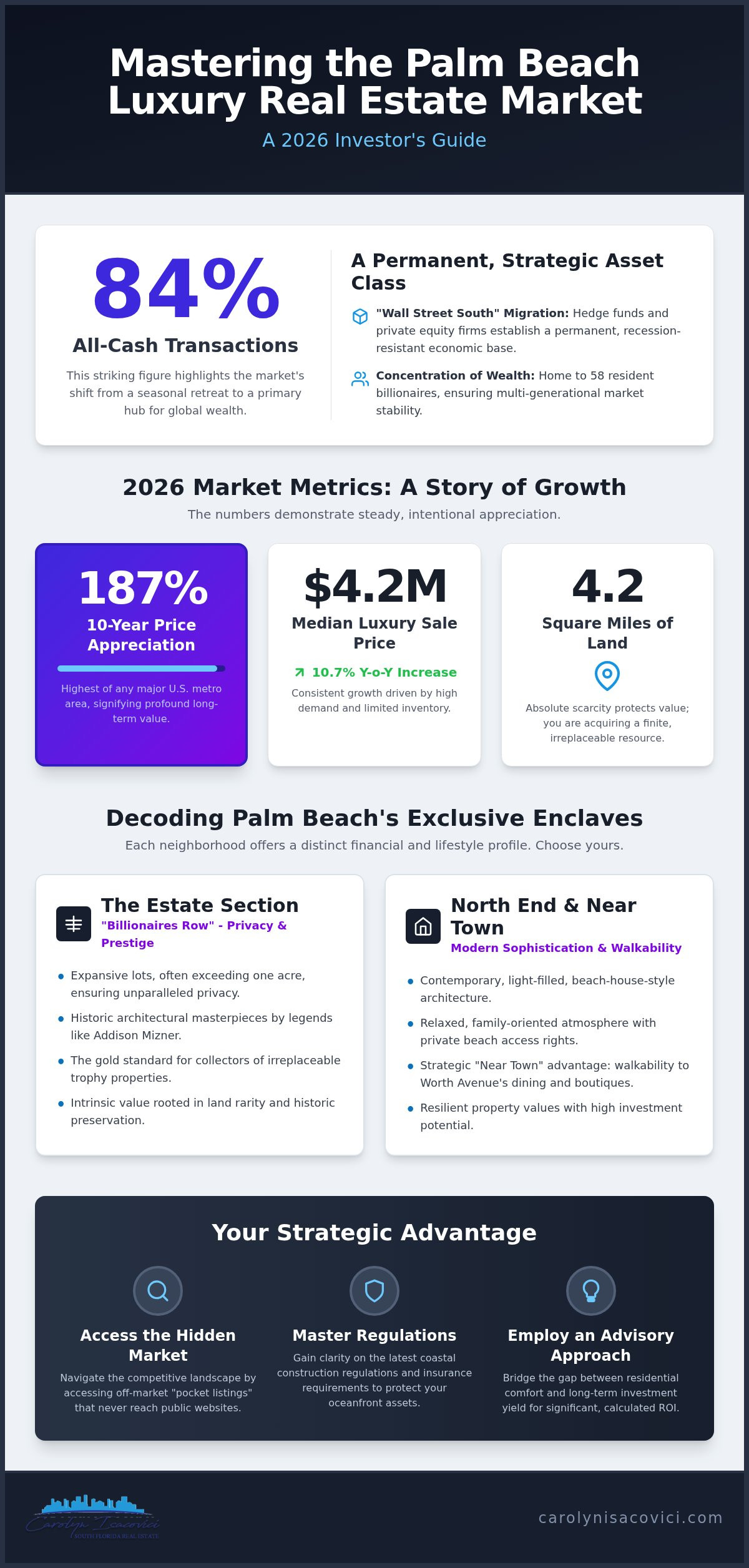
    Tax advantages further strengthen this thesis. Leveraging 1031 exchanges allows you to defer capital gains and roll equity into higher-value assets without immediate tax friction. For those establishing residency, Florida’s homestead rules provide a significant safety net. In 2026, the assessment increase for homesteaded properties is capped at 2.7%, ensuring your primary investment remains protected from runaway tax hikes.

    Managing the Asset: Beyond the Purchase

    The real work begins after the closing. For the absentee investor, professional management is the difference between a passive asset and a mounting headache. Maintaining “Asset Alpha” requires a focus on capital improvements that actually drive ROI, such as modernizing smart-home systems or investing in advanced sea-level mitigation. The “Luxury Hedge” is the strategic acquisition of high-utility, supply-constrained real estate that preserves capital by decoupling from broader market volatility through intrinsic lifestyle value. If you’re ready to refine your holdings, you can partner with Florida Commercial Investment Properties to audit your current strategy and identify new avenues for growth.

    Securing Your 2026 Florida Luxury Portfolio with Carolyn Isacovici

    How do you bridge the gap between market insight and a signed deed? In a landscape as dynamic as 2026, the answer lies in localized, advisory-first brokerage. Success in Florida luxury property investment isn’t just about finding a listing; it’s about navigating a complex ecosystem of insurance, tax caps, and structural integrity studies with a steady hand. Florida Commercial Investment Properties, led by Carolyn Isacovici, provides the analytical mind of a strategist combined with the empathetic ear of a consultant. We don’t just sell property. We partner with you to transform market uncertainty into a clear, actionable sense of opportunity.

    One of the most significant advantages we offer is access. While many buyers wait for notifications from public portals, the most compelling opportunities often never reach the MLS. Carolyn Isacovici leverages deep-rooted local relationships to identify undervalued luxury assets before they’re exposed to the broader market. This “off-market” edge is critical in high-demand enclaves where inventory remains structurally low. This strategy of private matching is a hallmark of elite markets globally, much like how DealDeed connects vetted buyers with exclusive off-market properties in Dubai. Our end-to-end support model ensures that from the initial selection to the final closing, every detail is managed with precision.

    Why does a 20-year history matter? It means we’ve seen every phase of the cycle. From the rapid growth of the Miami corridor to the emerging serenity of the Treasure Coast, our firm has navigated the shifts that define Florida real estate. We maintain a local presence in key corridors like Palm Beach and Jupiter, providing you with boots-on-the-ground intelligence that data alone can’t replicate. Whether you’re looking for new construction homes Florida or high-yield commercial assets, we provide a unified portfolio strategy. If you’re ready to move beyond the headlines, you can schedule a private portfolio consultation for 2026 to discuss your specific wealth preservation goals.

    Final Strategic Takeaways

    The 2026 luxury outlook is one of normalization and precision. Opportunity favors the prepared investor who recognizes that luxury real estate is a sophisticated institutional-grade hedge. As we’ve explored, the decoupling of luxury assets from broader market trends provides a unique window for capital preservation and long-term appreciation. Before you make your next move, consider reviewing our comprehensive guide on Florida real estate portfolio building. When you’re ready to secure your position in this resilient market, you can partner with Carolyn Isacovici for your next Florida luxury acquisition. We’re here to guide you through every step of the journey.

    Your Path to Resilient Wealth in 2026

    Are you ready to transform these market insights into a high-yield reality? The 2026 landscape offers a unique stabilization window for those who prioritize quality over volume. By focusing on asset utility and the supply-constrained enclaves of the Treasure Coast and Palm Beach, you’re positioning your capital for long-term preservation. Florida luxury property investment has matured into an institutional-grade hedge; however, success still hinges on the precision of your entry and the strength of your due diligence.

    Carolyn Isacovici has specialized in high-value Florida assets since 2006, providing deep local expertise across Miami, Palm Beach, and the Treasure Coast. Our advisory-first approach is built on the belief that your success is measured by long-term yield, not just a single closing. We’re here to help you navigate this cycle with confidence and clarity. It’s time to build a portfolio that reflects your vision for the future.

    Connect with Carolyn Isacovici for a Strategic Luxury Portfolio Consultation and secure your place in Florida’s most resilient markets. The right time to act is when you have the right partner by your side.

    Frequently Asked Questions

    Is 2026 a good year to invest in Florida luxury property?

    Yes, 2026 is a strategic year for acquisition because the market has transitioned into a “luxury reset.” While mortgage rates for a 30-year fixed sat at 6.99% in September 2026, the market has normalized from pandemic peaks. This shift means pricing is more precise and buyers have more leverage. Florida luxury property investment remains a resilient choice as domestic wealth migration continues to provide a firm floor for high-end asset values.

    Which Florida cities offer the highest ROI for luxury real estate?

    Miami and West Palm Beach currently offer the strongest momentum for luxury investors. As of July 2026, Miami saw an 18% year-over-year price increase, while West Palm Beach recorded a massive 43.9% surge in luxury sales volume. For those seeking long-term appreciation with lower volatility, the “Quiet Luxury” hubs of Jupiter and Stuart offer compelling price-to-value ratios. These areas benefit from limited inventory and high demand for waterfront estates.

    What are the main risks of luxury property investment in Florida?

    Rising insurance premiums and identifying true value in saturated corridors are the primary risks in 2026. Although Citizens Property Insurance implemented an 8.8% average rate cut on July 1, 2026, coastal coverage remains a significant line item. Modern investors must also pay close attention to condominium milestone inspection reports and structural integrity reserve studies. Ensuring a property is move-in ready is critical, as luxury buyers now prioritize assets that don’t require immediate renovations.

    How does new construction compare to resale for luxury investors?

    New construction is currently the preferred choice for investors seeking immediate utility and updated building codes. These homes command a premium because they meet 2026 energy-efficiency standards and offer modern flood mitigation. While resale legacy estates provide unique architectural character, they often come with higher insurance costs and potential modernization hurdles. Pre-construction remains a favorite for capturing equity, provided you have a trusted advisor to navigate developer timelines and structural integrity studies.

    Are there specific tax benefits for investing in Florida luxury real estate?

    Florida remains a premier destination for tax-conscious investors due to its lack of state income tax. In 2026, the homestead assessment increase is capped at 2.7%, protecting residents from rapid tax hikes. Investors should also watch the November 2026 ballot for a proposed constitutional amendment. If passed, it would significantly increase homestead exemptions in 2027. These favorable conditions continue to drive Florida luxury property investment as a primary strategy for capital preservation.

    What is the typical entry price for a luxury investment property in Miami vs. Stuart?

    Entry prices for luxury properties are significantly higher than the statewide median of $425,000. In Miami’s ultra-prime neighborhoods, luxury assets typically start well into the multi-million dollar range, driven by consistent 18% annual growth. Stuart offers a more accessible entry for “Quiet Luxury,” providing similar waterfront utility at a more favorable price-per-square-foot. Both markets reflect the premium of exclusive coastal living, but Stuart offers a higher price-to-value ratio for those seeking more space.

    How do I find off-market luxury listings in South Florida?

    Finding off-market opportunities requires a localized, advisory-first brokerage partner with deep community roots. Many high-value estates in Palm Beach and the Treasure Coast never reach public portals to maintain seller privacy. Carolyn Isacovici uses 20 years of established relationships to identify these “pocket listings” before they face general competition. This approach allows you to negotiate based on intrinsic value rather than responding to the pressure of a public bidding war.

    Can I use a 1031 exchange for a Florida luxury investment property?

    You can absolutely use a 1031 exchange to defer capital gains tax when selling an investment property and reinvesting in a Florida luxury asset. This is a common strategy for building portfolio synergy between commercial and residential holdings. By rolling equity into a higher-value asset of equal or greater value, you maintain your investment momentum without immediate tax friction. It’s a powerful tool for long-term wealth accumulation within the resilient Florida market.

  • Investing in Florida Single-Family Homes: The 2026 Strategic Guide

    Investing in Florida Single-Family Homes: The 2026 Strategic Guide

    What if the most competitive market in the country is actually your greatest opportunity for stability this year? It’s a question many seasoned investors are asking as they look at a median home price of $425,000 and 30-year mortgage rates hovering near 6.99%. You’ve likely noticed that the frantic pace of previous years has given way to a more balanced environment. This shift can feel uncertain, especially when you’re considering investing in Florida single-family homes while balancing 3.7% annual appreciation against the complexities of non-homestead tax caps. It’s natural to feel cautious, but in this stabilization, there’s profound opportunity for the disciplined buyer.

    We believe that the current market requires a more nuanced strategy than it did in the past. This guide provides the clarity you need to move forward with confidence. You’ll discover why a stabilizing market is a gift for those seeking long-term yield and how recent insurance rate decreases in 51 counties are changing the ROI equation. We’ll walk through the best submarkets for growth, the specific advantages of new construction, and how professional brokerage support can help you secure the off-market assets that define a high-performing portfolio.

    Key Takeaways

    • Understand how demographic-driven demand is shifting the focus of investing in Florida single-family homes from simple appreciation to a reliable hedge against market volatility.
    • Pinpoint the “Move North” corridors and high-tech hubs where job growth is outpacing housing supply to drive long-term value and rental demand.
    • Master the financial nuances of the 2026 market, including property insurance mitigation strategies and the impact of non-homestead assessment caps on your total ROI.
    • Evaluate the strategic trade-offs between the immediate yield of new construction and the hidden equity potential found in modernizing resale properties.
    • Gain insight into how professional brokerage partnerships unlock off-market deals and provide a steady hand in competitive regions like Miami and the Treasure Coast.

    The 2026 Landscape for Investing in Florida Single-Family Homes

    The market for investing in Florida single-family homes has entered a sophisticated new chapter in 2026. We’ve moved beyond the era of speculative frenzy into a period characterized by steady, demographic-led appreciation. While the median sale price reached $425,000 in mid-2026, the real story isn’t just the price; it’s the quality of the demand. High-net-worth individuals and corporate entities continue to relocate to the Sunshine State, seeking both lifestyle and fiscal advantages. This sustained in-migration has transformed the investment playbook. It’s a shift from the “fix-and-flip” mania of the early 2020s toward a more sustainable “build-to-rent” model that prioritizes long-term cash flow over rapid turnover.

    The “Florida Premium”: Why Demographics Win

    Population growth in 2026 remains robust, particularly among the 25-44 age bracket. These professionals are fueled by the ongoing tech expansion in South Florida and the Space Coast. Corporate relocations to hubs like Miami and West Palm Beach have created a permanent floor for rental demand that hasn’t been seen in previous cycles. Understanding the nuances of Florida property law, specifically how it governs tax liens and foreclosure processes, helps investors protect their capital in this competitive environment. Florida’s lack of state income tax remains the primary driver for out-of-state investors who want to maximize their net cash flow while building long-term wealth.

    Single-Family Rentals (SFR) as a Volatility Hedge

    Is your portfolio prepared for broader economic shifts? In 2026, single-family rentals have proven to be a remarkably resilient asset class when compared to the volatility of traditional equity markets. While commercial sectors face their own unique challenges, many are finding that a residential focus offers a more stable and predictable entry point. You can explore the specific trade-offs in our guide on commercial vs residential investment Florida.

    By focusing on Florida real estate portfolio building, you aren’t just buying houses; you’re securing a position in a market that has shown a 3.7% year-over-year price increase even as interest rates stabilized around 6.773%. This balance of growth and stability is exactly what a “calm expert” looks for in a premier asset class. With inventory levels at 4.5 months, buyers finally have the breathing room to make strategic decisions rather than emotional ones. The 2026 landscape is about timing and wisdom, ensuring your capital is placed where the people are moving.

    Targeting High-Growth Corridors: Where to Buy in 2026

    Success in investing in Florida single-family homes isn’t about buying anywhere in the state; it’s about identifying the specific corridors where demand is outstripping supply. In 2026, we’re seeing a distinct “Move North” trend. While the iconic southern metros remain strong, investors are increasingly looking at the Treasure Coast and the Space Coast for higher yield potential. Why is this happening? The answer lies in a combination of corporate migration and a search for relative affordability without sacrificing the Florida lifestyle. It’s a calculated shift that prioritizes long-term stability over short-term speculation.

    The Treasure Coast Opportunity: Port Saint Lucie to Stuart

    Port Saint Lucie has solidified its position as a top-ranking city for residential growth this year. It offers a compelling entry point for those who find the South Florida price tags prohibitive. In nearby Stuart and Jupiter, the focus has shifted toward high-quality rental assets that cater to a growing professional class. These areas benefit from significant infrastructure projects that are currently fueling property values. We often see that when transit and utilities expand, appreciation follows closely behind. It’s a classic “path of progress” play that rewards those who act with foresight and patience.

    South Florida Hubs: Miami and Palm Beach Gardens

    Miami and Hollywood FL continue to serve as safe haven markets for luxury single-family assets. These regions attract global capital and offer high-value rental opportunities that remain resilient regardless of broader economic shifts. Further north, Palm Beach Gardens has become a primary target for family-oriented, long-term rental demand. The inventory here is often competitive, with many of the best opportunities never reaching the public portals. Securing these assets requires a deep local network and an understanding of neighborhood-level dynamics that only comes from years of market presence.

    Melbourne and the Space Coast also deserve your attention in 2026. The influx of high-tech aerospace jobs has created a persistent residential scarcity that drives both rents and home values upward. Identifying these neighborhoods before appreciation peaks is the hallmark of a seasoned investor. If you’re ready to explore these high-growth submarkets, partnering with a specialized investment broker can provide the local insight necessary to identify deals before they hit the open market. It’s about moving with a steady hand in a market that rewards precision over speed.

    Financial clarity is the foundation of any successful venture. While headlines often focus on rising costs, the reality of investing in Florida single-family homes in 2026 is far more nuanced and, for the prepared investor, quite promising. Success here requires moving past surface-level numbers to understand the specific levers that drive net operating income. By mastering the interplay between insurance premiums, tax assessments, and rental yields, you can transform a standard property into a high-performing asset. It’s about looking at the full balance sheet with the steady hand of a strategist.

    The Insurance Equation: Risk vs. Reward

    The insurance landscape has reached a pivotal turning point. In 2026, homeowners insurance rates decreased in 51 of Florida’s 67 counties, signaling the first broad stabilization since 2019. To capitalize on this, focus your search on properties built under post-2002 building codes or those featuring recent upgrades like impact windows and modern roofing systems. These features don’t just protect the structure; they significantly lower your annual premiums. While insurance premiums are a factor, they are frequently offset by Florida’s higher-than-average rental growth, which continues to outpace national trends.

    Property Tax Planning for Non-Residents

    Understanding your tax liability is essential for accurate modeling. While Florida residents enjoy the “Save Our Homes” 3% cap, investment properties are subject to a 10% annual assessment increase cap. It’s vital to remember that taxes typically reset based on the new purchase price after a sale. If you’re buying at the 2026 median of $425,000, your first-year tax bill will likely be higher than the previous owner’s. Many of our clients find that holding these assets within a corporate structure provides additional layers of liability protection and potential fiscal advantages. You can learn more about these variables in our guide on how to evaluate investment property Florida.

    Yield Analysis: Cash Flow vs. Appreciation

    In 2026, the Melbourne market serves as an excellent case study for yield. With a strong influx of aerospace professionals, these properties often provide a healthy balance of monthly cash flow and steady appreciation. In contrast, coastal South Florida markets like Miami often see appreciation outpace immediate cash flow, making them “equity plays” for long-term wealth. For those looking to scale, 1031 exchanges remain a powerful tool to transition from single-family holdings into larger commercial assets. Using professional brokerage ensures you find “value-add” opportunities where minor modernizations can lead to outsized rental increases. This methodical approach ensures your portfolio remains resilient regardless of broader market cycles.

    Investing in Florida Single-Family Homes: The 2026 Strategic Guide

    Strategic Acquisition: New Construction vs. Resale

    Should an investor buy brand new or look for a diamond in the rough? When investing in Florida single-family homes, the choice between new construction and resale often depends on your tolerance for active management versus your desire for predictable cash flow. For those targeting the Tampa or St. Petersburg markets, professional resources like myfloridahoamanager.com can simplify the complexities of community standards and association compliance. Both paths offer distinct advantages in the 2026 market, provided you understand the underlying math. It’s about matching the asset type to your specific portfolio goals while remaining unruffled by the noise of the broader market. We see successful investors thriving in both lanes by applying a disciplined, analytical approach.

    The New Construction Advantage in 2026

    Why do seasoned investors lean toward new construction homes Florida? The answer is found in the “Total Cost of Ownership.” In 2026, tenants are increasingly prioritizing energy-efficient, modern builds that can withstand the Florida climate while keeping utility costs low. For the out-of-state investor, the “hands-off” nature of a new build is a significant draw. You benefit from comprehensive builder warranties and virtually zero capital expenditure (CapEx) for the first five years. Additionally, homes built to current 2026 Florida Building Codes qualify for the most substantial insurance discounts, which is a critical factor in maximizing your net yield.

    Maximizing Equity in the Resale Market

    Can you still find hidden value in established neighborhoods? Absolutely. The resale market in areas like Hollywood FL or Fort Lauderdale remains a prime hunting ground for those comfortable with modernization projects. This is where the BRRRR method (Buy, Rehab, Rent, Refinance, Repeat) thrives. By identifying properties with “good bones” but dated interiors, you can manufacture equity in a way that new builds don’t allow. However, the inspection process for older Florida homes is non-negotiable. You must be diligent about checking for mold, the age of the roof, and the integrity of the plumbing to avoid unforeseen costs. It’s a more active strategy, but the rewards in terms of forced appreciation can be substantial.

    Securing pre-construction pricing in emerging developments is another way to capture early-stage appreciation before a community is fully built out. This requires staying ahead of the curve and knowing which developers have the best track records for delivery and quality. Whether you prefer the predictability of a new build or the equity-building potential of a renovation project, we can help you navigate these choices. If you’re ready to see what’s available, you can browse our current investment property sales to find the right fit for your 2026 strategy. It’s a journey best taken with a partner who understands the nuances of both paths.

    Partnering with a Florida Investment Expert

    Is it possible to navigate a market as diverse as Florida’s on your own? While data is more accessible than ever, the wisdom to interpret it remains a rare commodity. When investing in Florida single-family homes, the difference between a standard purchase and a strategic acquisition often comes down to the quality of your partnership. A specialized investment broker doesn’t just show you houses; they provide a lens through which to view Miami real estate market trends and identify submarkets that align with your specific goals. This level of insight is particularly crucial in 2026, where the most lucrative opportunities often exist off-market, requiring a network built over decades.

    Carolyn Isacovici facilitates the end-to-end sales and acquisition process with a steady, confident hand. Since establishing her firm around 2006, she has helped investors navigate multiple market cycles without losing sight of the opportunity. Whether you’re securing your first property or looking to scale your portfolio from single-family homes into commercial holdings, our firm provides the strategic oversight needed for true diversification. We understand that your success depends on precision, timing, and access to assets that the general public rarely sees.

    Beyond the Transaction: Advisory and Strategy

    What are your primary objectives for 2026? Defining your investment criteria is the first step toward a successful acquisition. Whether you prioritize high-yield rentals in Port Saint Lucie or luxury appreciation in Miami, you need a local expert who understands the nuances of over 15 Florida cities. The right decision today builds the foundation for your wealth tomorrow. Ready to secure your Florida asset? Contact Carolyn Isacovici for a strategic consultation.

    Your Path Forward in the 2026 Florida Market

    Florida’s real estate landscape in 2026 offers a unique window for those who value strategy over speculation. By focusing on high-growth corridors like Port Saint Lucie and leveraging the insurance advantages of modern construction, you’re doing more than just buying property. You’re building a resilient hedge against market volatility. Success in investing in Florida single-family homes this year depends on your ability to see past the noise and identify the submarkets with sustained demographic demand.

    With 20 years of market experience, we specialize in helping you navigate both residential and commercial assets from Miami to the Treasure Coast. Our expertise ensures you have access to the off-market opportunities that define a high-yield portfolio. Are you ready to see what’s possible for your capital? View Exclusive Florida Investment Property Listings today to find your next premier asset. The right partnership makes all the difference, and we’re here to guide you every step of the way.

    Frequently Asked Questions

    Is Florida still a good place for real estate investment in 2026?

    Florida remains a premier destination for investing in Florida single-family homes because of its balanced 4.5 months of inventory and steady 3.7% year-over-year price growth. While the market has stabilized compared to previous years, demand is fueled by persistent population growth and corporate relocations. This environment allows you to make strategic, data-driven decisions without the pressure of a hyper-competitive frenzy. It’s a healthy, mature market that rewards long-term holders.

    How much should I budget for property insurance on a Florida single-family home?

    You should typically budget between $5,500 and $11,000 annually for a home with $300,000 in dwelling coverage. It’s encouraging to see that homeowners insurance rates decreased in 51 of 67 counties in 2026, marking a significant shift in affordability. To keep your premiums on the lower end of this range, focus on properties built to modern codes or those with updated roofs and impact windows. Professional mitigation strategies are key to protecting your yield.

    Which Florida cities offer the highest rental yields for single-family homes?

    High-growth corridors like Port Saint Lucie, Fort Pierce, and Melbourne currently offer some of the most compelling rental yields. These “Move North” submarkets benefit from lower entry prices compared to Miami while attracting a professional tenant base. In Melbourne, the aerospace industry provides a steady stream of high-income renters. By targeting these “path of progress” areas, you can secure assets where rental demand consistently outpaces the existing housing supply.

    Can I use a 1031 exchange to buy a single-family home in Florida?

    Yes, you can absolutely use a 1031 exchange to acquire a Florida single-family home, provided the property is held for investment or business use. This is a powerful tool for deferring capital gains taxes while repositioning your capital into high-growth regions like the Treasure Coast. Many of our clients utilize this strategy to scale their portfolios, eventually moving from individual residential units into larger commercial property holdings with the help of specialized brokerage.

    What are the tax benefits of investing in Florida residential property?

    The most significant benefit is the lack of state income tax, which immediately improves your net cash flow. Additionally, Florida law limits annual assessment increases on non-homestead properties to 10%, providing a layer of predictability for your carrying costs. A proposed 2026 amendment could even lower this cap to 5% for non-school levies. These protections, combined with demographic-driven demand, make the state a fiscally attractive environment for both domestic and international investors.

    Should I buy new construction or an existing home as an investment?

    The choice depends on your specific goals for investing in Florida single-family homes this year. New construction offers lower insurance costs, builder warranties, and minimal maintenance for the first five years, making it ideal for a “hands-off” strategy. Conversely, existing homes in established areas like Hollywood FL allow for forced appreciation through renovation. If you prioritize immediate cash flow and lower capital expenditures, new builds are often the superior choice in the 2026 landscape.

    What is the average appreciation rate for Miami real estate in 2026?

    Miami real estate continues to see healthy growth, with the statewide median sale price increasing by 3.7% as of July 2026. While the rapid spikes of the early 2020s have moderated, Miami’s status as a global “safe haven” keeps demand high for luxury single-family assets. We’ve seen the median home price reach $425,000 across the state, with coastal metros often commanding a premium due to inventory scarcity and sustained interest from high-net-worth individuals.

    How does the Florida “Homestead Exemption” affect investment properties?

    The Homestead Exemption is reserved for primary residents and doesn’t apply to investment properties. This means your property will be assessed at its full market value upon purchase, and you won’t benefit from the $51,411 exemption. However, you’re still protected by the 10% annual assessment cap on non-homestead properties. Understanding this distinction is vital for accurately calculating your long-term ROI and ensuring your tax modeling reflects the reality for non-resident owners.